
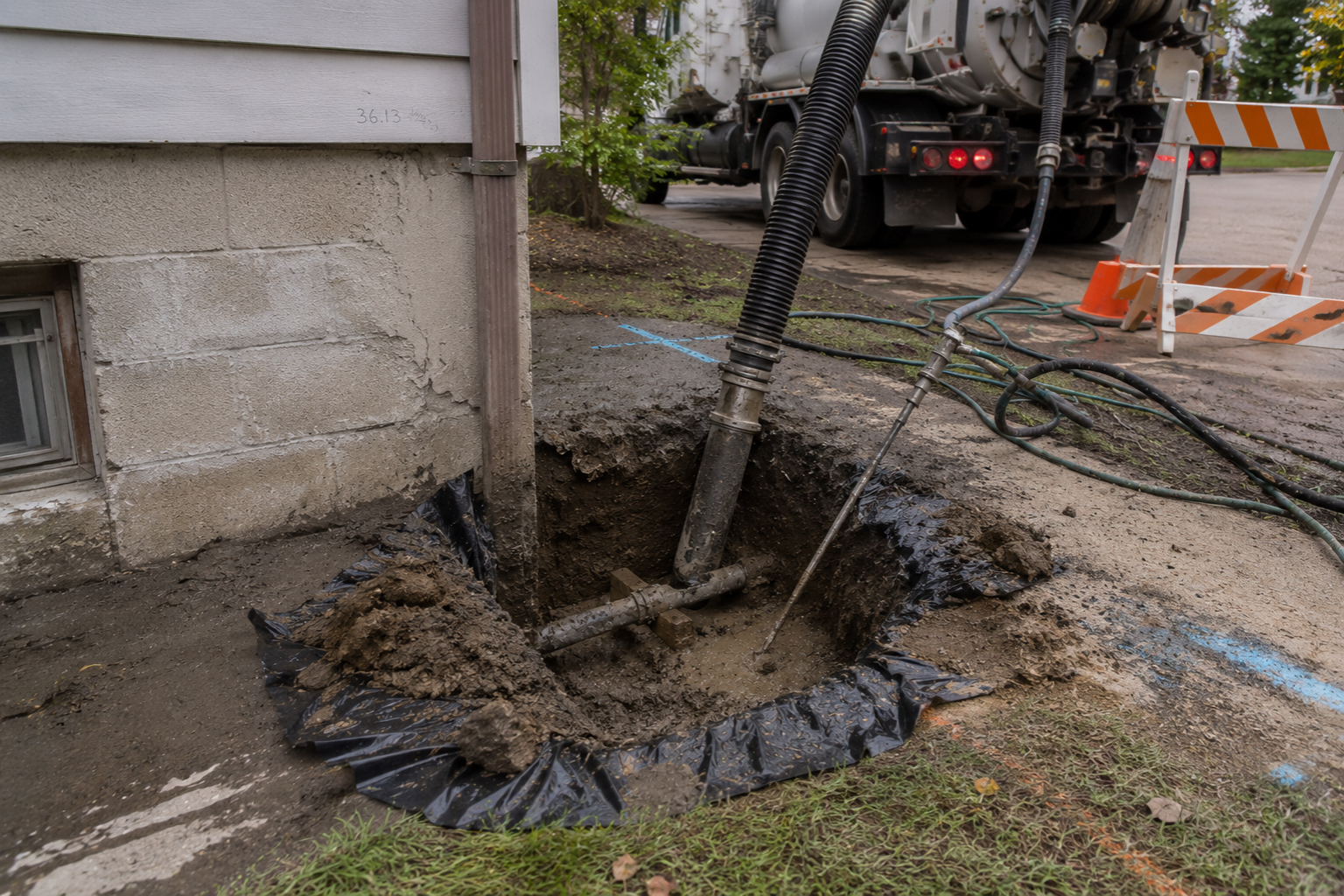

Hydrovac is useful when a crew needs to see what is in the ground before larger equipment gets close. It is not the fastest or cheapest way to remove a large volume of ordinary soil.
The method uses pressurized water to loosen soil while a vacuum hose pulls the wet material into a debris tank. That control makes hydrovac valuable around utilities, existing foundations, congested sites, tree roots, and short excavations where a steel bucket carries too much damage risk.
It still creates an excavation. Utilities can still be damaged, soil can still be washed from beneath a footing, and every tank of slurry still needs somewhere to go.
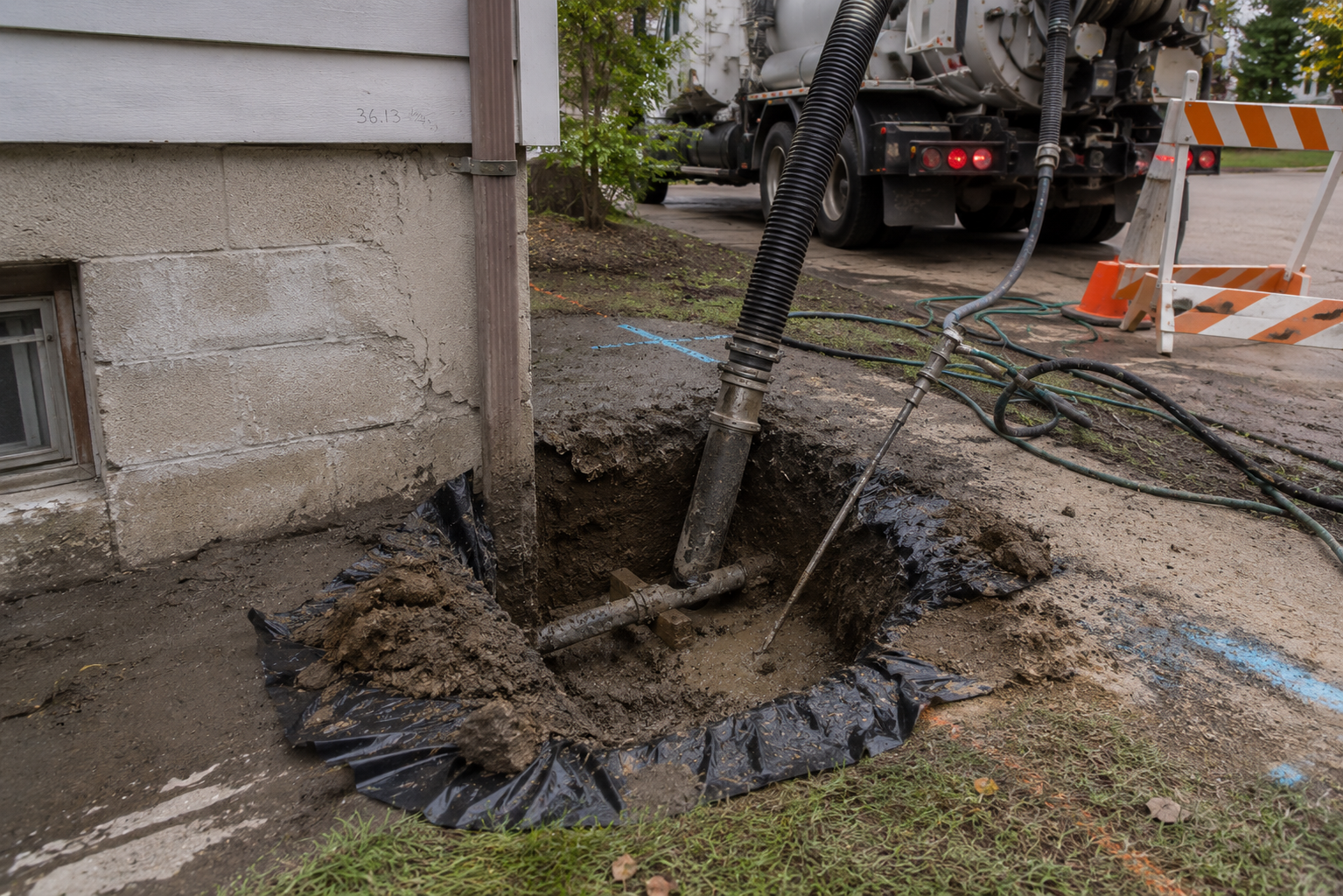
Hydrovac is most useful when a crew needs to expose utilities or investigate conditions beside an existing foundation without using a steel bucket in the sensitive area. Image by ArchitectureCourses.org.
Hydrovac Is a Precision Method, Not a Universal Replacement
Hydrovac excavation, hydro excavation, vacuum excavation, and non-destructive digging are often used as overlapping terms. The common process is simple: loosen the ground without bucket teeth, then remove the material through suction.
The term non-destructive should not be taken literally. A poorly controlled water jet can damage cable coatings, plastic pipe, insulation, roots, weak masonry, and the soil supporting a foundation.
Hydrovac reduces mechanical contact. It does not remove the need for utility locates, excavation protection, engineering, or an experienced operator.
Where Hydrovac Earns Its Place
Utility Daylighting and Potholing
Utility marks show an approximate route. A test hole confirms the line’s actual horizontal position, depth, material, and direction.
Hydrovac is commonly used to expose gas, electrical, communication, water, and sewer lines before mechanical excavation, drilling, trenching, or foundation repair proceeds nearby.
One exposed point does not prove the line continues straight. Changes in depth, direction, or material may require several test holes.
Short Slot Trenches
Hydrovac can open a short, narrow trench for a crossing, service connection, drain, conduit, or inspection point where several utilities occupy the same corridor.
It is less convincing for a long, clear trench on an open site. Once utility conflicts are exposed and documented, a trencher or excavator may complete the remaining work faster.
Tight Access
The truck can remain on a street or driveway while hoses reach into a narrow side yard, courtyard, crawl space, plant room, or fenced area.
Long hose runs, bends, vertical lift, poor truck positioning, and repeated disposal trips reduce production. Access that looks possible on a plan may still be slow in the field.
Existing Foundation Investigation
A controlled test excavation can expose a footing, wall base, drain, utility crossing, previous repair, or suspected void without opening a long trench.
This can provide useful information before exterior waterproofing, underpinning, addition work, or a larger foundation excavation.
Sensitive Roots and Existing Construction
Vacuum excavation can remove soil around roots and fragile buried construction with less cutting than a conventional bucket. Pressure, exposure time, drying, and loss of soil support can still cause damage.
Where Hydrovac Is Usually the Wrong Tool
- Large open excavations: A conventional excavator is usually more productive for a basement or broad foundation footprint.
- Long clear trenches: Once utility conflicts are resolved, a trencher or excavator may complete the run at lower cost.
- Hard rock and large boulders: Hydrovac can clear soil around them, but it does not replace breakers, drilling, saw cutting, or rock excavation.
- Work that needs reusable dry soil: Hydrovac turns the excavated material into slurry that may not be suitable for immediate backfill.
- Sites with poor disposal access: Tank capacity, haul distance, receiving-site restrictions, and dump time can erase the production advantage.
A practical excavation plan may use hydrovac only at utility crossings and sensitive areas, then switch to mechanical excavation for the main soil volume.
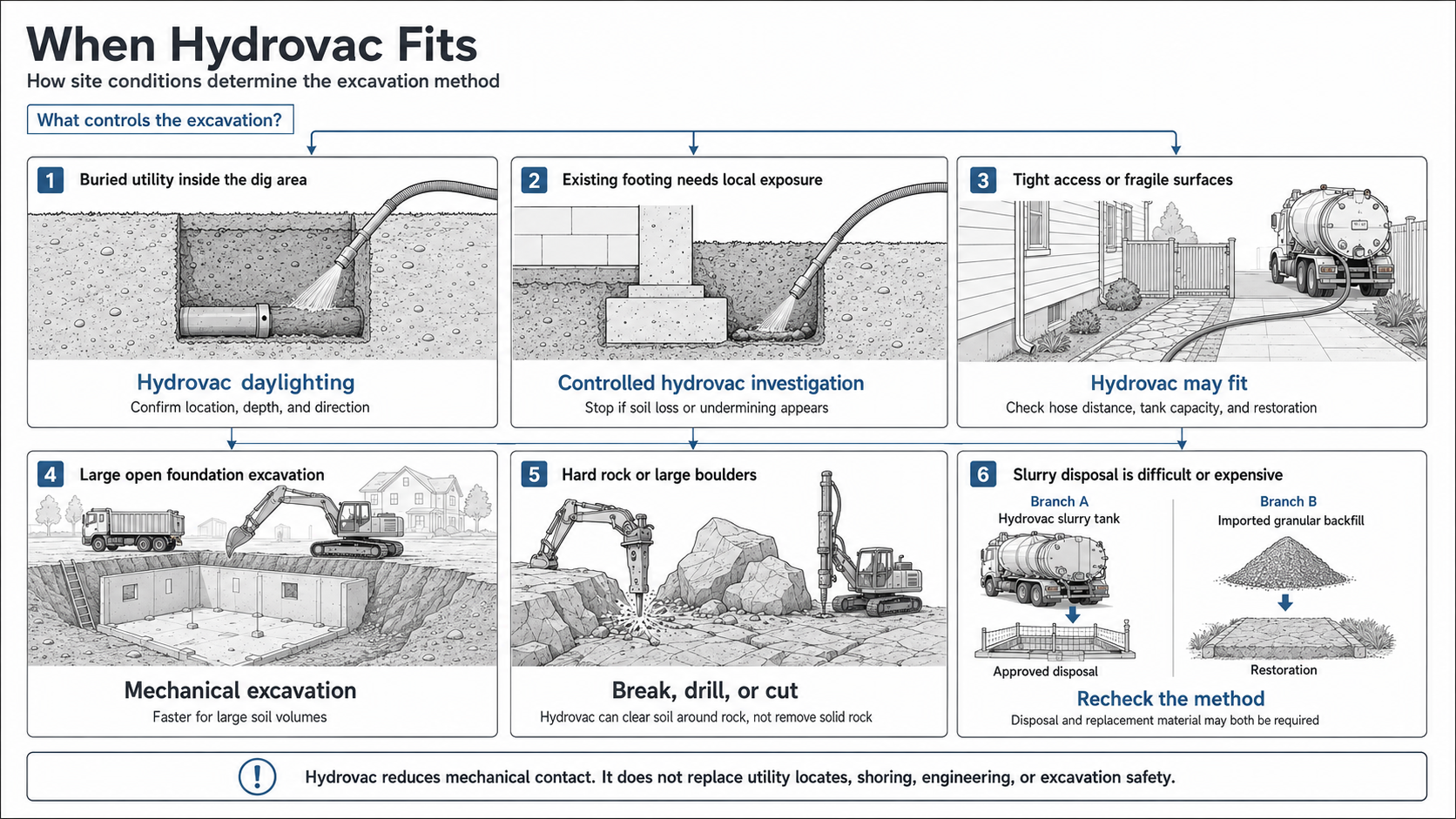
Hydrovac works best for controlled exposure and congested areas. Open excavations, long clear trenches, hard rock, and disposal-heavy work may suit another method. Illustration by ArchitectureCourses.org.
The Utility Locate Still Comes First
Hydrovac does not replace the required utility-notification and locating process.
- Request the required public utility locates before excavation.
- Identify private lines that the public locate may not mark.
- Review local tolerance-zone rules and utility-owner instructions.
- Mark the proposed test-hole locations.
- Begin with controlled nozzle movement and the lowest practical pressure for the material being exposed.
- Expose enough of the utility to confirm its position, depth, direction, and condition.
- Measure and document the exposed line.
- Protect it from impact, bending, traffic, unsupported weight, and weather.
Plastic pipe, conduit, cable insulation, protective coatings, and fiber can still be damaged by poor nozzle control. Hydrovac lowers the contact risk; it does not make damage impossible.
Digging Beside a Footing Can Still Cause Settlement
Water loosens soil. That is how hydrovac works, and it is also the main concern beside an existing footing.
The operator can remove fine soil from beneath the footing edge, enlarge a hidden void, soften bearing material, or carry soil away through an old utility trench. The visible opening may stay small while erosion reaches farther below the foundation.
Stop work if the excavation exposes flowing sand, loose masonry, an unsupported footing edge, unexplained voids, or water carrying soil from beneath the building.
Excavation below an existing footing may require engineered sequencing, shoring, monitoring, or foundation underpinning. Hydrovac changes how soil is removed. It does not provide structural support.
Hydrovac, Air Vacuum, Hand Digging, or Excavator?
| Method | Best use | Main limitation |
|---|---|---|
| Hydrovac | Utility daylighting, short controlled excavations, restricted access, cohesive or frozen soil | Produces slurry and depends on water, tank capacity, hauling, and disposal |
| Air vacuum excavation | Sensitive exposure where dry spoil recovery and soil reuse are valuable | Production can fall in dense clay, wet ground, and frozen soil |
| Hand digging | Small shallow openings, final cleaning, and work under specific utility-owner rules | Slow, physically demanding, and still capable of damaging utilities |
| Mechanical excavation | Large soil volumes, open sites, and clear areas outside sensitive zones | Greater contact risk and surface disturbance near unknown or fragile features |
Soil Conditions Control Production
- Clay: May need more water and repeated cutting before it will move through the hose.
- Sand: Can remove quickly but may run, cave, or wash from beneath nearby construction.
- Gravel and rubble: Small material may pass through the system; larger pieces need hand or mechanical removal.
- Frozen soil: Heated water can help, but water demand, fuel use, icing, visibility, and production still change the job.
- Roots: Soil can be removed around roots, but pressure, exposure, and loss of support can still injure them.
- Contaminated soil: May require testing, separate handling, special disposal, and additional worker protection.
Hose length, hose diameter, vertical lift, truck position, water supply, debris-tank capacity, and disposal distance can matter as much as soil type.
Slurry Is Where Cheap Quotes Break Down
Hydrovac does not create a neat pile of dry soil. It creates a mixture of water, fine soil, gravel, and debris inside the truck.
That slurry may need to be hauled to an approved site, dried, separated, tested, or processed before reuse. Requirements depend on the material, project, municipality, utility owner, and receiving facility.
Raw slurry should not be poured beneath a slab, footing, pavement, or foundation wall and treated as compacted structural backfill.
Imported granular backfill may be required even though a truck has already removed all the original material. Disposal and replacement material can both appear on the same invoice.
A truck may also fill before the excavation is finished. Every disposal trip stops production unless another truck is available.
Hydrovac Does Not Replace Excavation Protection
A narrow vacuum-excavated hole can still collapse, collect water, undermine nearby construction, expose a hazardous atmosphere, or trap a worker.
The work still needs the controls that apply to its depth and conditions, including competent-person inspections, safe access, water control, utility protection, surface-load control, and a protective system where workers face a cave-in hazard.
Truck position, traffic, outriggers, hoses, and nearby equipment must also be considered. Removing the spoil into a tank does not make the excavation wall stable.
What the First Test Hole Can Reveal
The first hydrovac hole often provides more useful information than another marked line on a plan.
It may expose:
- A utility outside the marked position.
- An undocumented private service.
- A footing wider or shallower than expected.
- Loose fill or buried construction debris.
- An abandoned drain or previous repair.
- Active groundwater or soil loss beneath a foundation.
It can also show that the planned method is wrong. Flowing sand, weak masonry, heavy rubble, or repeated tank filling may push the project toward shoring, hand excavation, mechanical equipment, or a revised structural sequence.
Record utility depth and direction, footing dimensions, soil changes, water, and obstructions before the opening is backfilled.
What a Hydrovac Quote Should Include
- Mobilization, minimum call-out, crew size, and expected working hours.
- Truck type, debris capacity, and coverage during disposal trips.
- Water source, water charges, and responsibility for refilling.
- Truck position, hose length, vertical lift, and traffic control.
- Number, size, and expected depth of test holes or trenches.
- Assumptions about soil, frozen ground, rubble, roots, and groundwater.
- Utility-owner coordination and private-locate responsibilities.
- Estimated slurry volume, included tank loads, haul distance, and disposal charges.
- Standby, overtime, blocked-access, and additional-disposal rates.
- Imported backfill, compaction, pavement, concrete, landscaping, and restoration.
An hourly truck rate is not enough to compare proposals. Travel, waiting, tank trips, disposal, and unfinished restoration can cost more than the digging time.
FAQ
Is hydrovac safe around buried utilities?
It is widely used to reduce mechanical contact while exposing utilities. It can still damage coatings, plastic pipe, cable insulation, conduit, and fiber when pressure, distance, or nozzle movement is poorly controlled.
Does hydrovac replace the utility locate?
No. Required utility notification and locating come first. Hydrovac is then used to physically confirm the marked line’s position and depth.
Can hydrovac excavate below a foundation footing?
It can remove the soil, but that does not make the excavation structurally safe. Work below a footing may require engineered underpinning, shoring, sequencing, and monitoring.
Is hydrovac cheaper than an excavator?
It can be economical for short sensitive excavations, utility crossings, and restricted access. An excavator is usually cheaper for moving large soil volumes on an open site.
Can hydrovac slurry be reused as backfill?
Not in its raw wet state beneath structural work. The material may need drying, separation, processing, testing, or replacement with approved compacted fill.
Can hydrovac remove rock?
It can clear soil from around fractured rock and smaller loose pieces. Solid rock and large boulders usually need drilling, breaking, cutting, or mechanical removal.
Does hydrovac work in frozen ground?
Heated water can cut frozen soil, but production, fuel, water use, icing, tank capacity, and disposal determine whether the method is practical.
Who normally hires the hydrovac contractor?
General contractors, utility contractors, municipalities, engineers, foundation contractors, and property owners may arrange the work. Responsibility for locates, traffic control, disposal, restoration, and documentation should be assigned in writing.
Read This Next
- Foundation Excavation Methods and Techniques
- Foundation Underpinning: Methods, Risks, and What It Fixes
- Basement Underpinning Cost: What Changes the Price