
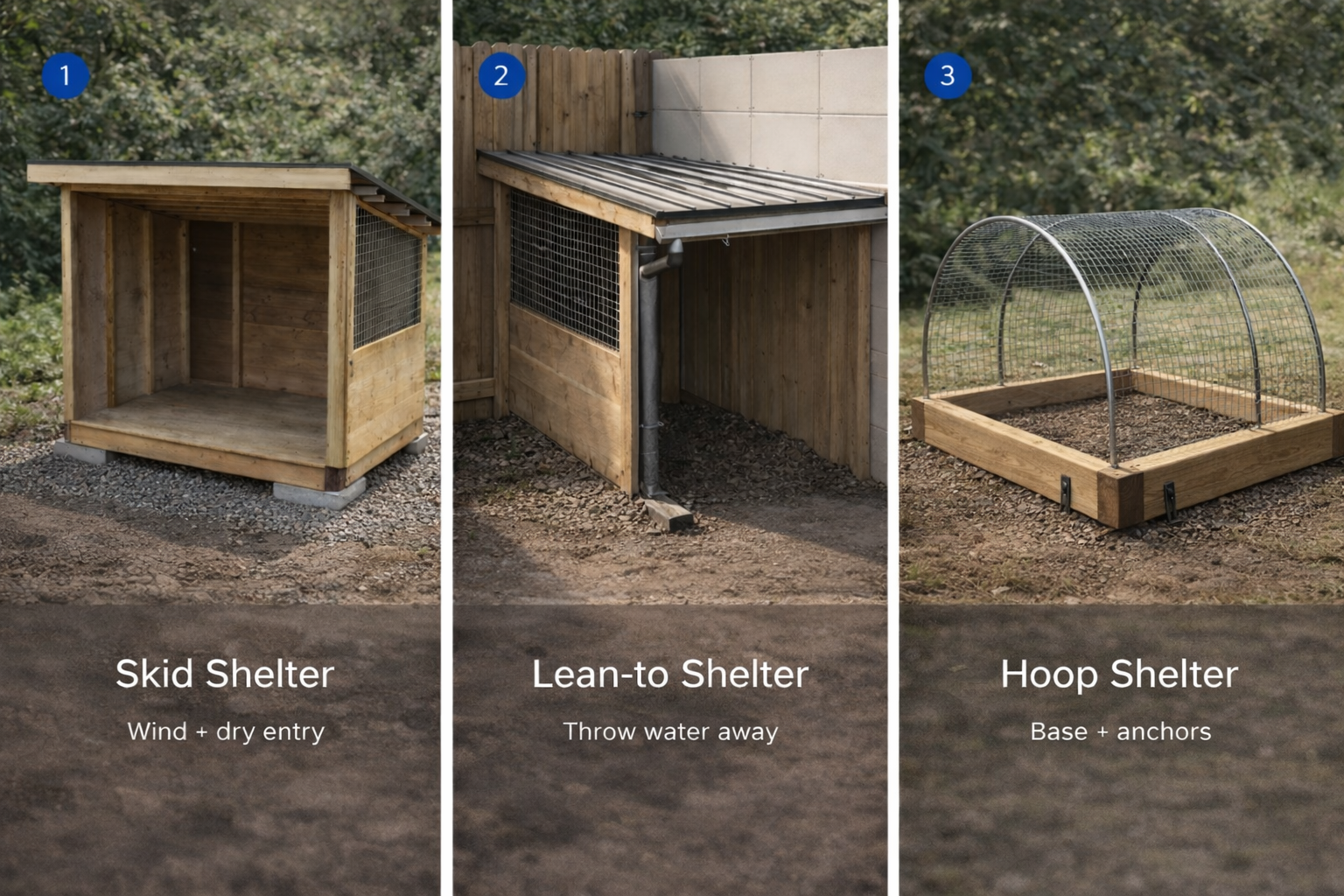
Skid, Lean-to, or Hoop? The Small Coop Frame Choice That Saves Rebuilds
The first coop I built wasn’t really a plan. It was lumber in the driveway and rain coming. I framed a little box, threw a roof on it, set it right on soil, and called it “good enough.”
It was good enough… until fall. The doorway never really dried. Not flooded. Just always slightly wrong. Bedding stayed damp-ish. Smell showed up before anything looked rotten, which is the annoying part — it tricks you into thinking the coop is “fine.”
After doing a few of these in normal backyards (mine, friends, a couple neighbors), you stop comparing coop styles and start noticing behaviors. The shape decides what the ground, water, and wind are allowed to do.
If you’re still in the “collecting layouts” phase, keep this open too: small coop layout ideas. This page is the frame decision that keeps those layouts from backfiring.
Three Backyard Coop Shapes People Keep Rebuilding (And One They Keep)
What people think they’re choosing vs what they’re actually choosing
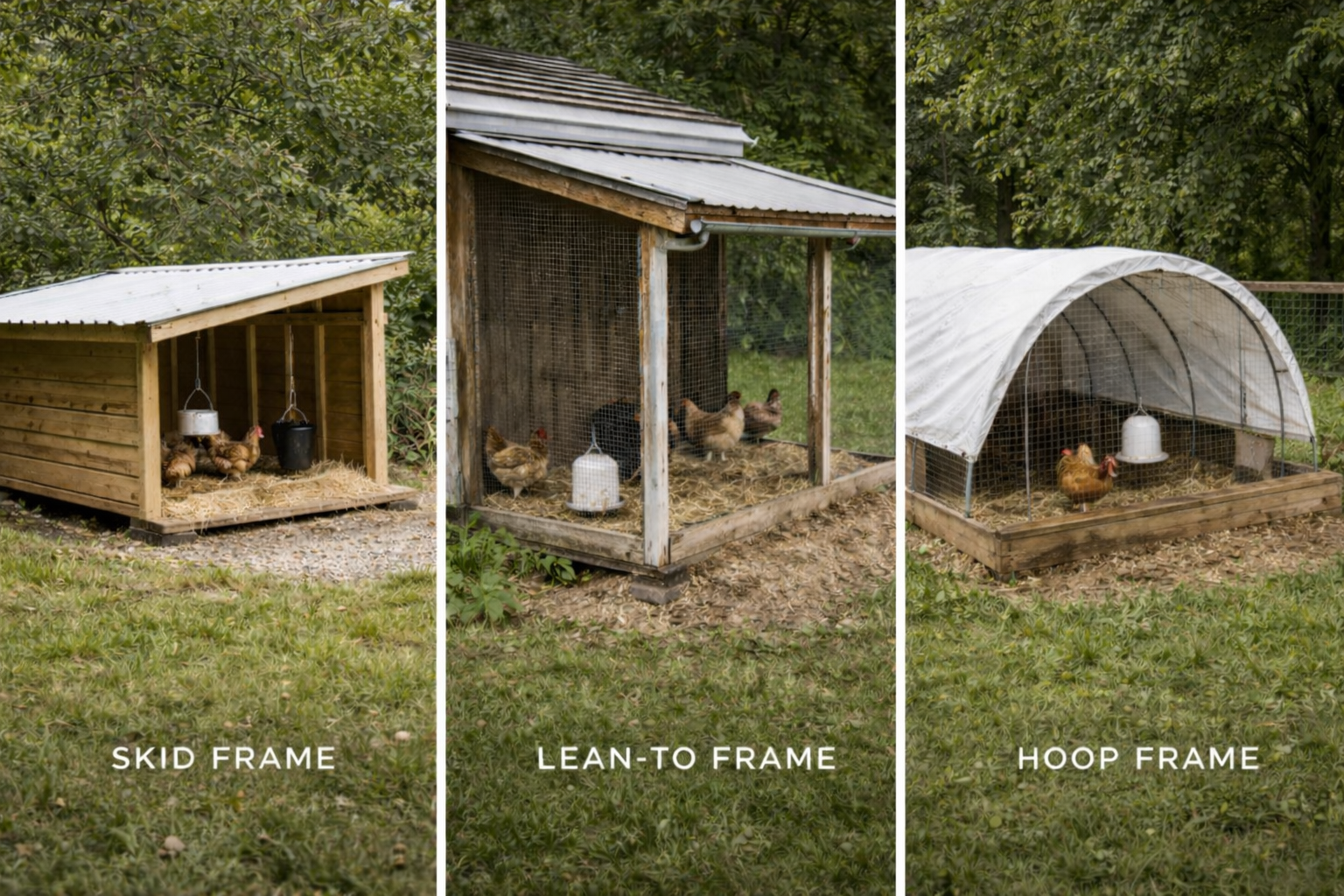
Most folks obsess over square footage first. Real life, the yard picks the coop. Two coops with the same dimensions behave completely different if one traps moisture at the entry and the other sheds it.
Small flocks make this worse in a weird way. With 2–6 birds, they hammer the same spots every day: the door zone, the feeder zone, the “waiting” spot. If that spot stays wet, the whole coop feels dirty no matter how tidy the inside is.
If you want the big-picture basics (and the stuff people argue about constantly), I keep that over here: chicken coop construction FAQs.
Skid shelter — the one that stops fighting the ground
The second coop I built went on skids almost by accident. I had leftover runners and I didn’t feel like leveling the yard again. That one change fixed most of what was bugging me.
What ended up happening was the coop stopped caring about the yard. Air moved under it. Water passed under it. The birds stayed cleaner because the entry area wasn’t a permanent damp strip anymore.
- Works in wet yards where footprints stay visible for days after rain
- Handles freeze/thaw winters better because the coop isn’t bonded to the mud
- Helps when the run turns to soup before the coop does
The only “upgrade” I kept doing after each winter wasn’t thicker walls. It was boring stuff: more roof overhang and a firmer landing at the doorway. That’s what stopped the mud trench.
If you’re trying to keep this build cheap without building something disposable, this page pairs well: cheap coop builds that actually last.
RECOMMENDED TOOL (Amazon)
1/2" 19-gauge hardware cloth (welded wire mesh) — this is the “stop losing birds” material for doors, vents, and lower run walls. Example: a 1/2" 19-gauge hardware cloth roll (Land Guard / Fencer Wire / VEVOR-type rolls).
One more reality: four birds standing on damp bedding smell worse than eight standing dry. People don’t believe that until they’ve lived it.
Lean-to — fast if you already have a solid wall, but roof water will punish you
A neighbor wanted the coop hidden beside a fence. We basically built half a shed and let the fence be the back wall. It went up fast and it actually stayed calmer inside because one side was already wind-blocked.
Then the first heavy rain hit and the roof dumped water exactly where the birds stood all day. Not a leak — just constant wet ground right at the traffic zone.
After adding a gutter (and tweaking the roof edge so it threw water away from the entrance), the coop behaved normally again. Same box, different water path.
- Good for narrow side yards and “out of the way” runs
- Nice when you don’t want a freestanding coop dominating the yard
- Usually feels warmer than a freestanding coop of the same size because of the borrowed wind wall
If you’re looking for the broader “shelter first” mindset (not just coops), this is the companion page: DIY chicken shelter builds.
FIELD PICK (Amazon)
Automatic coop door (timer/light sensor style) if predators are a real issue where you are — it removes the “one night you forgot” problem. Example: VEVOR-style automatic coop doors are common budget picks.
The lean-to itself rarely fails structurally. The failure is usually the runoff pattern. Chickens reuse one standing zone over and over — if roof water lands there, you get smell before you get rot.
Hoop shelter — quick coverage, but only if the base is serious
Hoops are fast. I tried one as quick shade cover in a rotation area. First month: perfect. After a couple windy weeks: it shifted a little. Then a little more.
Nothing dramatic. Wind doesn’t “push” a hoop over — it works the base loose in little cycles until something tears or the whole thing goes sloppy.
We rebuilt it with a wooden base frame and anchored the base, not the hoop pipes. After that, the shape stopped creeping.
- Best for summer shade and rotational runs
- Works when you want coverage more than a rigid structure
- Needs a real base if it’s staying put through storms
If you’re aiming for a more “proper” shed-style build (still backyard scale), this is the bigger build path: how to build the ultimate chicken coop.
Quick chooser
(the version that matches what actually happens)
- Wet / uneven ground → skid shelter
- Tight yard / shared wall → lean-to shelter
- Rotation / summer shade → hoop shelter (with a rigid base frame)
Once the frame choice is right, the “design ideas” finally behave. If you want a bunch of layouts after you pick the frame, this hub is the browse page: best coop designs by backyard type.
What usually fails after one season
(so you can spot it early)
- Smell at the doorway → the landing area never dries (ground + roof throw problem)
- One filthy corner → runoff or wind-driven rain entering the same spot daily
- “Everything loosened up” → anchoring/base connection slowly walking in wind cycles
People blame ventilation for a lot of this, but half the time it’s just moisture getting imported at the entry, day after day.
More details (build vs buy vs upgrade) here: Chicken Coop Guide: What to Build, What to Buy, What to Fix.
Small-flock layout problems that are really “shape” problems
When a coop is slightly damp, nesting boxes get gross fast. Birds don’t politely keep the mess “over there.” They track it everywhere and then sleep on it.
If you’re building roll-away boxes to keep eggs clean, these are the two nest-box builds I’ve used as references when someone wants the cleaner setup: a simple roll-away nest box design and the 3-compartment roll-away version.
MUST READ (Amazon)
Storey’s Guide to Raising Chickens (Gail Damerow) — not because it’s fancy, just because it answers the boring questions people end up googling at 10pm after something goes sideways.
FAQ
(the questions people actually ask after the first month)
Does a raised coop get colder?
It gets drier. Dry birds handle cold better than damp birds handle mild weather. The “cold” complaints usually come from drafts, not elevation.
Is a lean-to less secure from predators?
Usually it’s more secure on the back side (because the wall is solid). The weak points are the door edges and low openings. That’s where the hardware cloth and latches matter.
Are hoop coops only temporary?
They’re temporary if they’re anchored like a tent. Put them on a base frame and anchor the base, and they stop doing the slow-walk thing in wind.
Why does my coop still smell even when I clean it?
Because the doorway zone never dries. It’s not always “dirty,” it’s wet. Different problem.
If you want the broader starting point (definitions, parts, common layouts), that’s here: Chicken Coop. And if you just want to browse idea galleries and variations, this one stays useful: chicken coop ideas.
But if you’ve only got time to make one decision before buying lumber: pick the frame behavior that matches your yard. That’s the part that decides whether you’re proud of it next spring or quietly rebuilding it.