
Chicken Coop Hub: Designs, Runs, Nest Boxes, and Build Details
Types, features, building, and buying tips.
Chicken coops are one of those “simple” builds that get expensive when you miss the boring stuff. Ventilation. Predator pressure. Mud and drainage. Cleaning access. Winter swings. And the big lie: that the coop is the only thing that matters. Most problems start in the run, the floor, or the way the whole thing handles moisture.
This hub is the map. Use it to pick a direction, avoid the common traps, and build something that survives seasons (not just the first weekend).
The Failure Map: the 12 problems people have
(and the first fix)
Most chicken-coop advice online is backwards: it talks about cute features, not failure modes. Real coops don’t fail dramatically — they get annoying. Mud, smell, mites, frozen water, predators testing weak points, and hens laying eggs anywhere except the nest boxes.
Use this like a quick diagnosis. Don’t “upgrade everything.” Fix the one thing that changes the system.
| Problem you notice | What it usually means | The first fix that matters |
|---|---|---|
| The run turns to mud fast | Too much bare soil + no roof/drainage plan | Add a covered zone + improve drainage surface (gravel pad / raised edge / slope) |
| Ammonia smell in winter | Humidity trapped + not enough high ventilation | Add high vents above roost height (airflow without drafting the birds) |
| Condensation / frost on walls | Warm moist air can’t escape | Vent high + reduce water source inside (wet bedding, unsealed leaks) |
| Eggs laid on the floor | Nest boxes are in a bad location or too exposed | Make nests darker/quiet + adjust height and access |
| Hens sleep in nest boxes | Roosts are too low, uncomfortable, or badly placed | Fix roost height/spacing so roosting is the obvious choice |
| Coop feels “always damp” | Ground moisture + no air movement + base too close to grade | Get the coop off the ground and add ventilation where moisture exits |
| Predator “attempts” (scratches, chewing) | Weak perimeter detail (edges, corners, apron) | Add hardware cloth + skirt/apron detail at the base |
| Predator got in through the door | Latch/hardware is decorative, not secure | Upgrade latches + add a second positive lock point |
| Water freezes constantly | Too much exposure + no protected water zone | Move water into a sheltered area or use a safer winter setup |
| Coop is “hard to clean” | Bad access, bad floor, no clean-out strategy | Add clean-out door + simplify bedding/floor setup |
| Mites keep coming back | Too many cracks/crevices + no cleanable surfaces | Seal rough joints + make interior surfaces cleanable (then treat) |
| Coop shifts / goes out of level | Foundation choice doesn’t match the site | Upgrade base: skids/blocks/slab based on drainage + frost movement |
If you want to build the coop so you never see these problems in the first place, start with the build guides above — and don’t underbuild the run.
Start here: pick a direction (ideas + choosing what you’re actually building)
This is the “I don’t even know what I want yet” section. Start here if you’re deciding between small vs. walk-in, cheap vs. built-for-10-years, and what style actually fits your yard. Most bad coops weren’t built badly — they were picked badly.
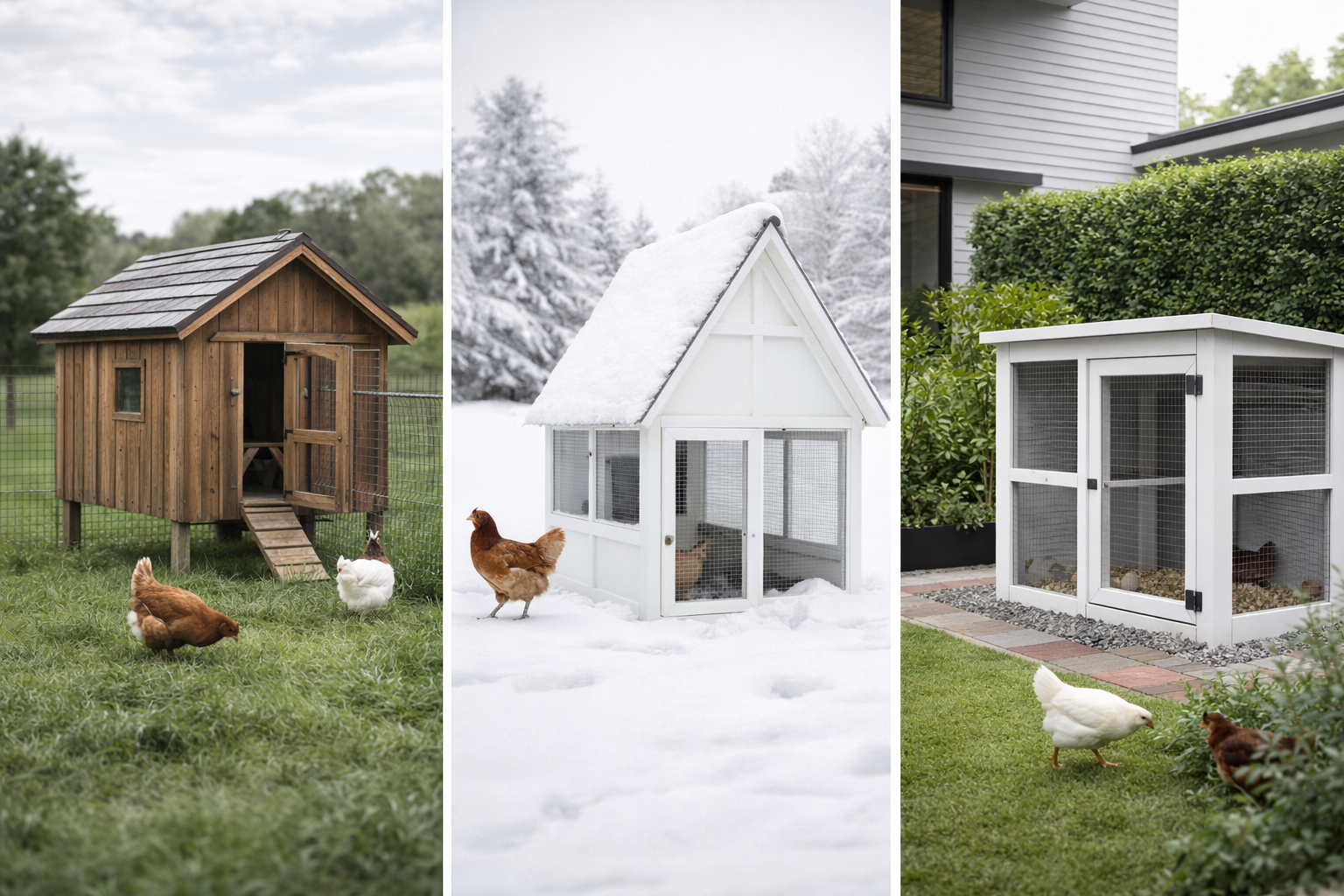
- Chicken Coop Ideas — broad layouts, styles, and what works in real backyards
- Best Chicken Coop Designs — a tighter shortlist with “why this one” notes
- Small Chicken Coop Ideas — when you’re tight on space (or keeping a small flock)
- Cheap Chicken Coop Ideas That Actually Last — budget builds that don’t turn into repairs
Build guides: step-by-step execution
If you already know what you’re building and you want a clean path from layout to framing to finishes, this is your section. These are the “do the work” pages — fewer opinions, more sequence.
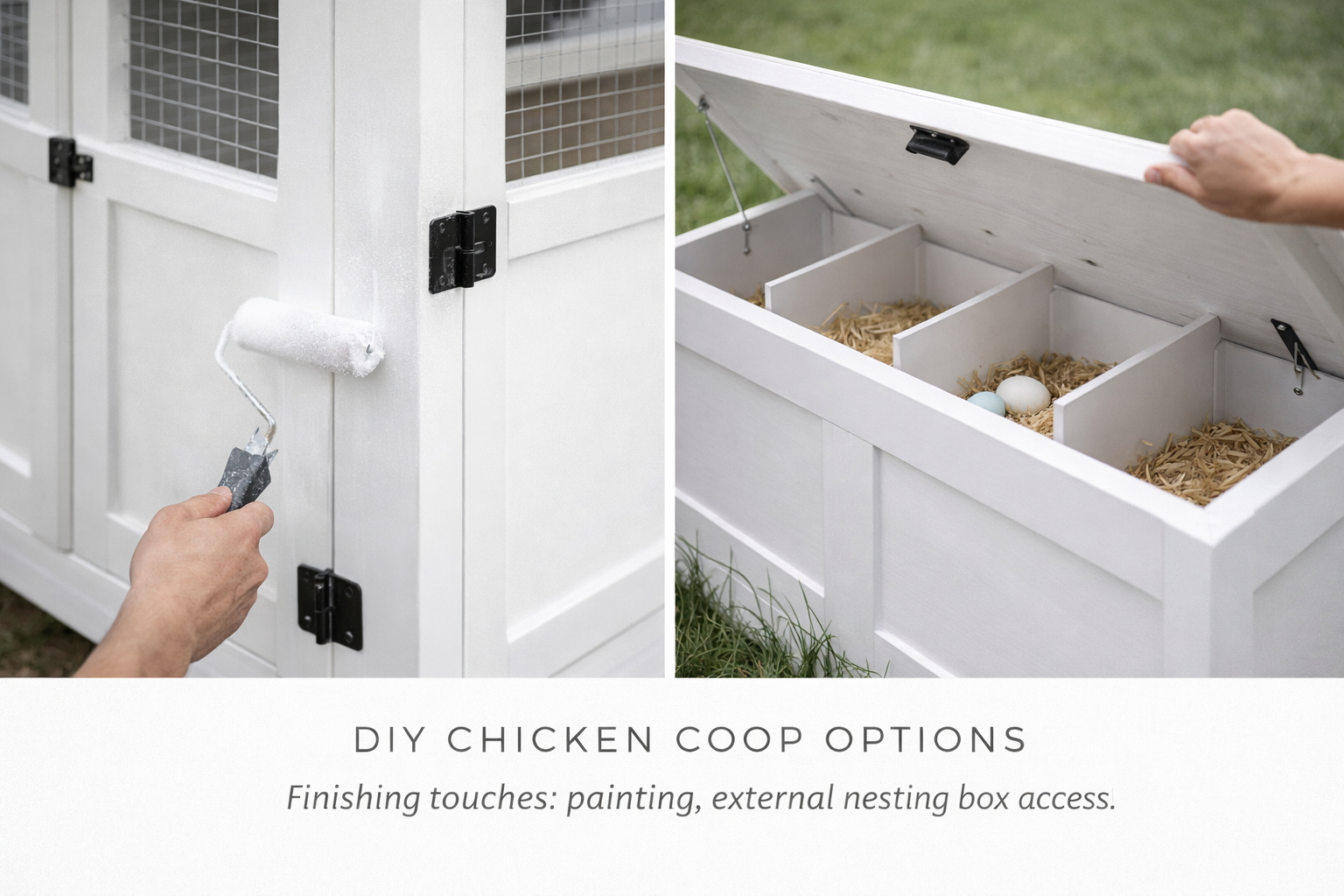
- How to Build the Ultimate Chicken Coop — full build path, the “main” guide
- DIY Chicken Shelter — lighter build, faster shelter-focused option
Runs and outdoor space (where most people underbuild)
Coops get all the attention. Runs get whatever is left over. That’s backwards. Runs decide mud, smell, predator pressure, and whether your yard turns into a worn-out trench by mid-season.
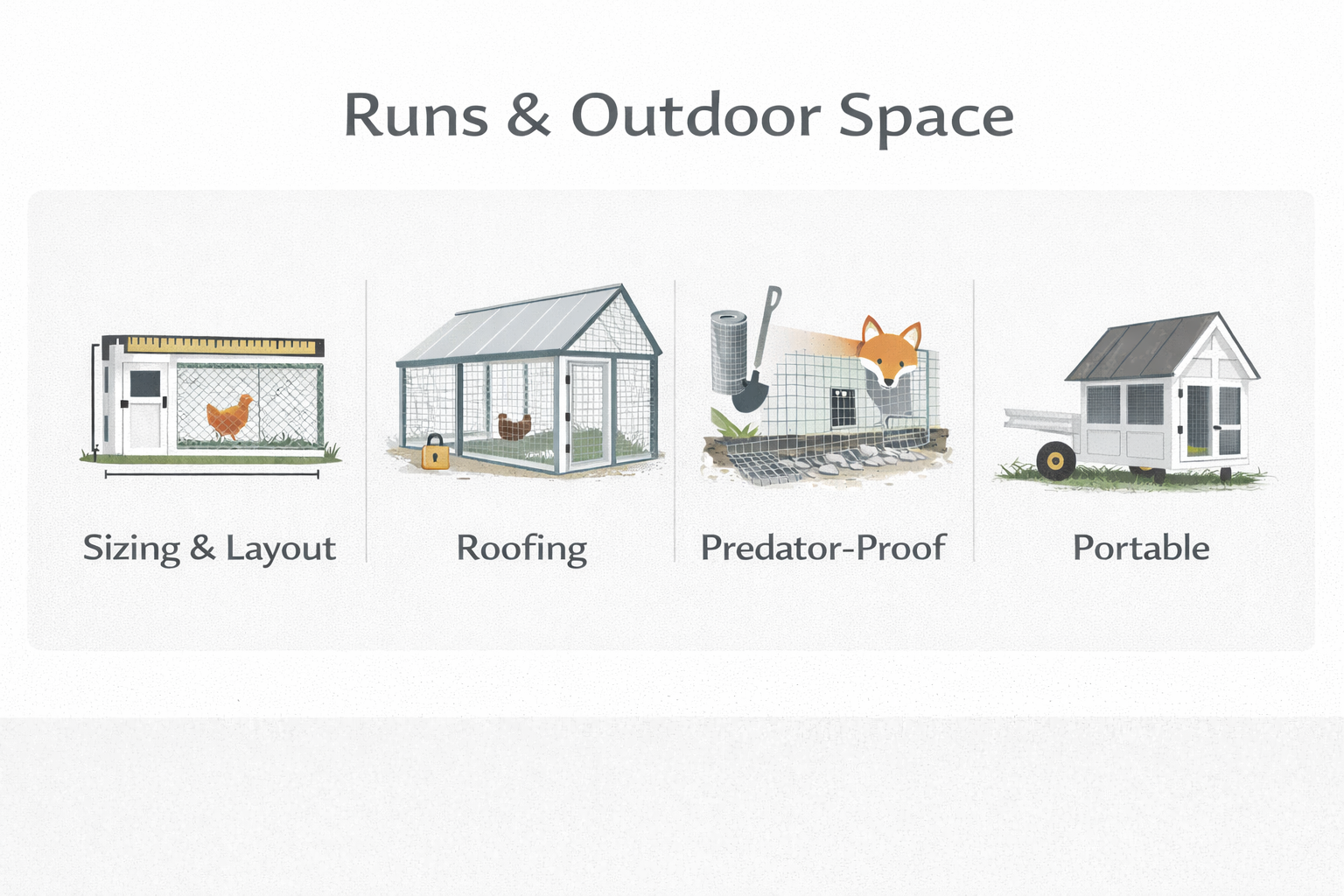
- Chicken Runs: Size, Layout, Roofing, and Anchoring (coming soon)
- Predator-Proof Chicken Run Details: Hardware Cloth, Aprons, and Latches (coming soon)
- Covered vs. Open Runs: Mud, Shade, Snow Load, and Cleanup Reality (coming soon)
- Portable / Moveable Runs: What Actually Stays Put in Wind (coming soon)
Predators and security (the stuff that “nice coops” still fail at)
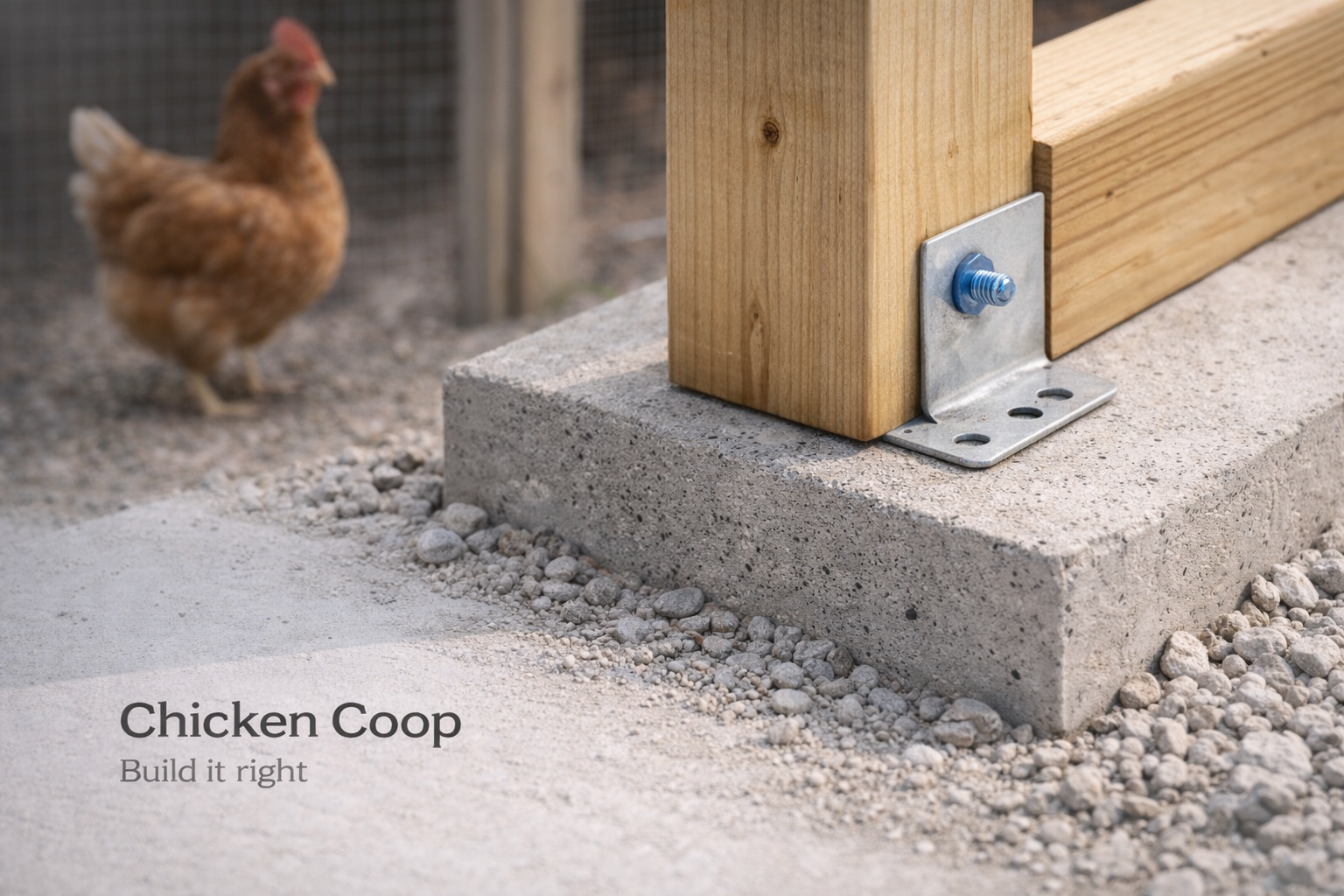
Predator-proof isn’t “strong wood.” It’s details. Edges. Latches. Weak corners. The places hands don’t check until something gets in. This section is about the failure points that show up again and again.
- Predator-Proof Chicken Coop: Weak Points That Get Hit First (coming soon)
- Chicken Wire vs. Hardware Cloth: Where Each Belongs (and where it doesn’t) (coming soon)
- Doors, Hinges, Latches: The Small Hardware That Decides the Outcome (coming soon)
Cold weather, ventilation, and “why it smells like ammonia”
Winter problems are usually moisture problems wearing a winter coat. The smell, the condensation, the frost on walls — that’s ventilation and humidity management, not “your chickens are gross.” Get airflow wrong and everything else gets harder.
- Chicken Coop Ventilation: Winter-Safe Airflow Without Drafting the Roost (coming soon)
- Insulated Chicken Coops: When It Helps, When It Traps Moisture (coming soon)
- Heated Chicken Coops: Safe Options, Fire Risk, and What Not To Do (coming soon)
- Winterizing a Coop and Run: Wind, Snow, and Condensation Control (coming soon)
Interior layout (nest boxes, roosts, and the daily-use details)
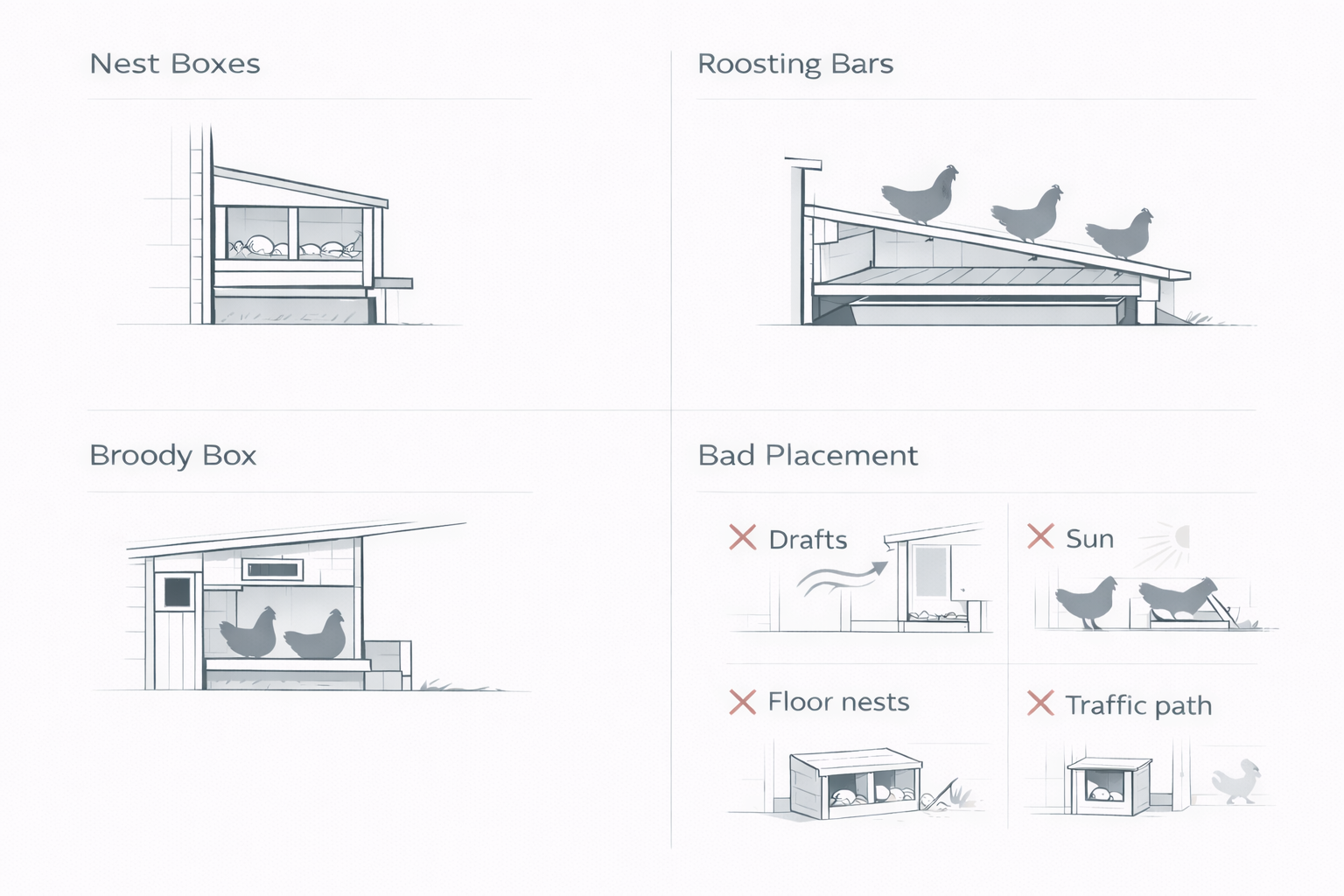
This is the part you feel every day. Egg collection. Cleaning. Where droppings land. Whether you can reach anything without crawling. A coop can be “well built” and still be annoying to live with if the interior layout is lazy.
- DIY Roll-Away Chicken Nest Box — compact roll-away design
- 3-Compartment Roll-Away Chicken Nest Box — bigger setup for larger flocks
- Roosting Bars: Height, Spacing, Droppings Management, and Bad Layouts (coming soon)
- Nest Box Placement: Privacy, Drafts, Egg Collection, and “Why They Lay on the Floor” (coming soon)
- Broody Box / Broody Coop Setup: Simple, Safe, and Not Overbuilt (coming soon)
Floors, foundations, and keeping the base dry
If the base stays wet, the coop ages fast. Rot, smell, flies, and a floor that never really cleans. This section is about staying off the ground, staying level, and not building a little sponge.
- Chicken Coop Foundations: Skids vs. Blocks vs. Slab (and what stays level) (coming soon)
- Floors That Clean Easily: Materials, Drainage, and Rot Resistance (coming soon)
- Keeping Mud Out: Drainage, Gravel Pads, and Run Surfaces That Don’t Turn to Soup (coming soon)
Size, capacity, and planning (before you cut anything)
People either undersize the coop or overspend on something huge they don’t want to clean. The planning pages are where you decide space per bird, roost length, nest count, and what kind of access you actually need.
- How Big Should a Chicken Coop Be? Space per Bird, Roost Length, Nest Box Count (coming soon)
- Walk-In Chicken Coops: When It’s Worth It (and what it costs you) (coming soon)
- Mobile Chicken Coops / Chicken Tractors: Good Uses, Bad Uses, and Build Details (coming soon)
Maintenance and cleanup (make it easy or you won’t do it)
Maintenance is where “cute backyard coop” turns into “why did I do this.” If the layout doesn’t support cleaning, you’ll procrastinate, and then you’ll be stuck doing a gross job at the worst time of year.
- Cleaning a Chicken Coop: Layout tricks that cut the work in half (coming soon)
- Bedding Choices + Odor Control: Keeping Ammonia Down Without Overthinking It (coming soon)
- Access Doors, Drop Pans, and “Easy Clean” Features That Are Actually Useful (coming soon)
Buying vs. building (prebuilt coops, kits, and what to watch)
Prebuilt coops aren’t automatically bad. But a lot of them are built like patio furniture: thin panels, weak hardware, and “looks good online” design. This section helps you spot the weak points before you pay for them.
- Chicken Coops for Sale: What to check before you pay (materials, hardware, ventilation) (coming soon)
- Cheap Prebuilt Coops: Common failures and simple reinforcements (coming soon)
The three coop shapes people keep ending up with
(after the first mistake)
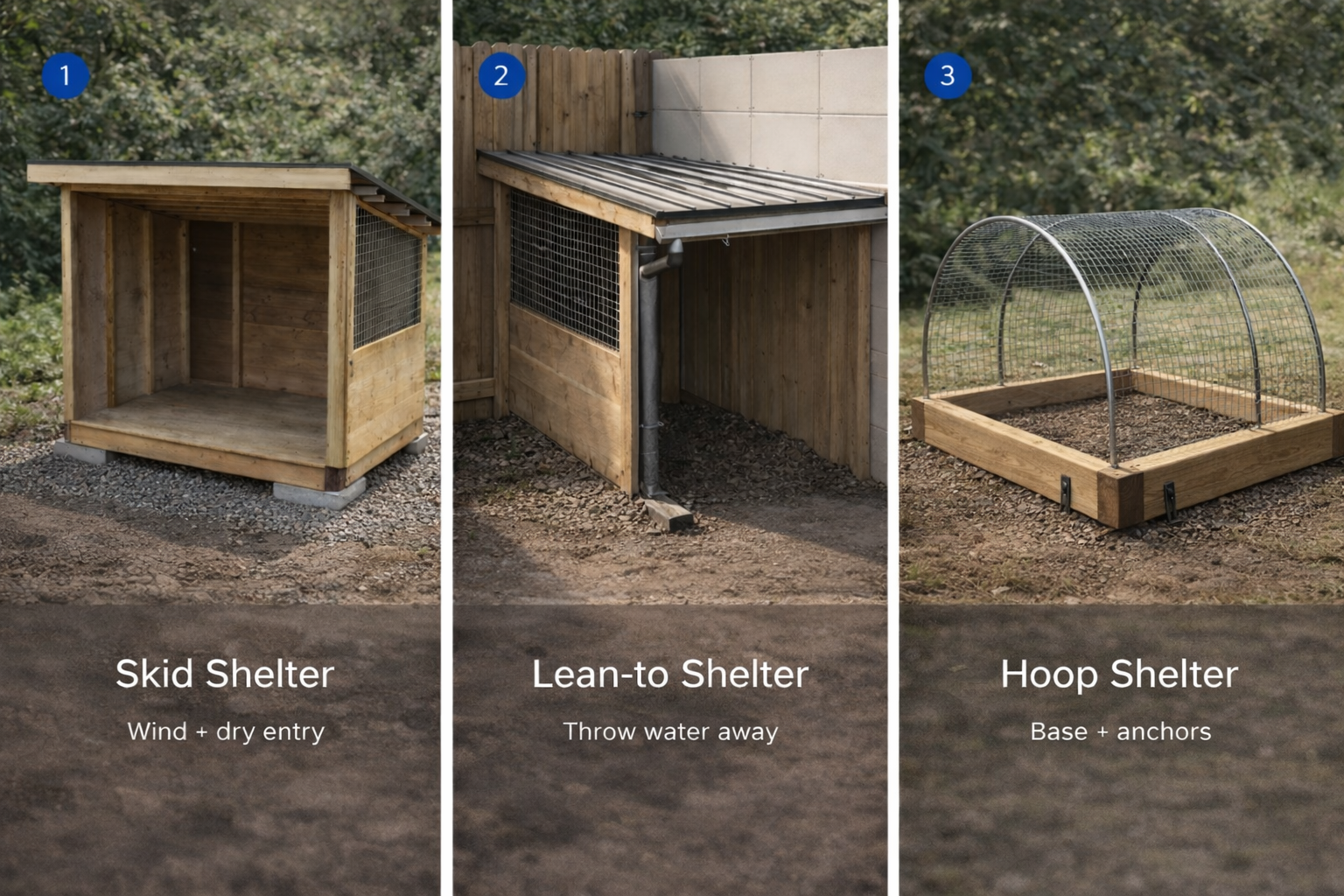
Most small coops I’ve seen didn’t start as a plan.
They started as “just something quick so the birds are out of the rain” — then a season passes and suddenly you’re rebuilding the same box but slightly different.
After doing a few for my own yard and a couple for neighbors, the patterns repeat.
Not styles — behaviors.
The shape decides what the ground, water, and wind are allowed to do.
The picture shows the same three that keep coming back because they don’t create new problems later.
Skid shelter — the one that stops fighting the ground
The first coop I built sat flat on soil. Looked fine.
By fall the entrance turned into a permanent damp strip. Not flooded, just always wrong. Bedding never really dried.
The next one went on skids almost by accident — I had leftover runners and didn’t want to level the yard again.
What ended up happening was the coop stopped caring about the yard.
Air moved under it. Water passed under it. Chickens stayed cleaner.
Where this shape quietly works:
-
yards that stay soft after rain
-
freeze / thaw winters
-
places where the run becomes mud first, not the coop
The only change I kept making after each winter was more roof overhang and a firmer step area.
Not bigger walls. Not thicker lumber. Just keeping the entry from turning into a trench.
For small flocks this matters more than floor space.
Four birds standing in damp bedding smell worse than eight standing dry.
Lean-to — the one that borrows strength but punishes bad roof lines
A neighbor wanted the coop hidden beside a fence.
We basically built half a shed and let the fence be the back wall.
It went up fast and actually stayed warmer because the wind was already blocked.
The problem showed up the first heavy rain — the roof dumped water exactly where the birds stood all day.
Not a leak. Just constant damp ground.
After adding a gutter the place behaved normally again.
Where this shape keeps showing up:
-
narrow side yards
-
behind garages
-
places where the coop shouldn’t dominate the yard
The structure itself rarely fails.
It’s almost always the runoff pattern. Chickens reuse one standing zone over and over — if roof water lands there, you get smell before you get rot.
Hoop shelter — the one people rebuild unless the base is real
Hoops look temporary but people end up keeping them.
I tried one as a quick shade cover. First month: perfect. After a couple windy weeks: it shifted a little. Then a little more.
Nothing dramatic — just enough movement to loosen wire and pull staples.
We rebuilt it on a wooden base frame and anchored that instead.
After that the shape stopped creeping.
Where it actually fits:
-
rotation areas
-
summer heat
-
moving birds around grass
The frame rarely breaks.
It just slowly works loose unless the bottom edge is treated like a real structure.
Why these matter before picking “ideas”
People usually compare coop layouts — nesting boxes, doors, paint colors.
But every rebuild I’ve seen happened for the same reason:
They picked a shape that fought the yard.
Small coops especially don’t have buffer space.
Whatever moisture or wind behavior you allow becomes the daily living condition.
So the choice ends up simple:
-
ground stays wet → skid solves it
-
space is tight → lean-to disappears into the yard
-
heat and movement matter → hoop works once anchored properly
After that, almost any small design works.
Before that, even a nice build turns into maintenance.
More details here: The Right Coop Frame for 2–6 Birds (Mud + Wind Tested).
FAQs and troubleshooting
(when you just need an answer)
This is the quick help section. The “something went weird” questions: smell, moisture, predators, egg-laying problems, and what to change first without rebuilding everything.
- Chicken Coop Construction and Design FAQs — common questions, mistakes, and fixes
How to use this hub (quick workflow)
- Start with the ideas pages to pick a coop style that fits your yard and flock.
- Decide the run strategy next. Most “coop problems” are run problems.
- Lock in predators + ventilation early. Retrofitting those later is always uglier.
- Then build from the step-by-step guides and component pages.