

Most likely you won’t lose money because you “can’t estimate” (even though you will miss stuff sometimes). You lose money because tendering is messy in real life: unclear drawings, late addenda, missing details, subs who ghost you until the last hour, and a deadline that doesn’t care.
So don’t try to be perfect. Be clear. Write your assumptions down. Call out what’s missing. Add time/money for the risk, or don’t bid it. That’s it.
Here’s the key thing people mix up: estimating is your internal number. tendering is the formal promise you submit (price + forms + scope + schedule assumptions + risk you just agreed to carry). If you treat building construction tenders like “just send the estimate,” that’s how you win work and still lose.
What this guide is: a practical way to price, qualify, and submit without getting trapped by scope gaps, bad assumptions, or “included by default” items that nobody priced.
What this is not: a textbook definition of tendering and estimating.
Tendering vs estimating
(quick, because people mix them up)
Your estimate is your internal number: takeoff, labor, subs, equipment, overhead, risk.
Your tender is the package you submit: price, forms, schedule, clarifications, exclusions, alternates, bonds, and whatever the owner asked for.
You can have a solid estimate and still lose because your tender was missing one stupid form. Or you can win with a bad estimate and spend a year regretting it.
The stuff that actually breaks bids
It’s usually one of these:
- Scope gaps: “I thought that was included” becomes change orders and arguments.
- Bad assumptions: you assumed access, staging, working hours, shutdown windows, weather, inspections… nobody agreed.
- Sub quotes that don’t match: everyone is pricing a different scope, then bid day becomes guessing.
- Schedule fantasy: you priced it like it’s smooth, but procurement and sequencing are not smooth.
Construction Tendering:
The Real Process
(and Where It Breaks)
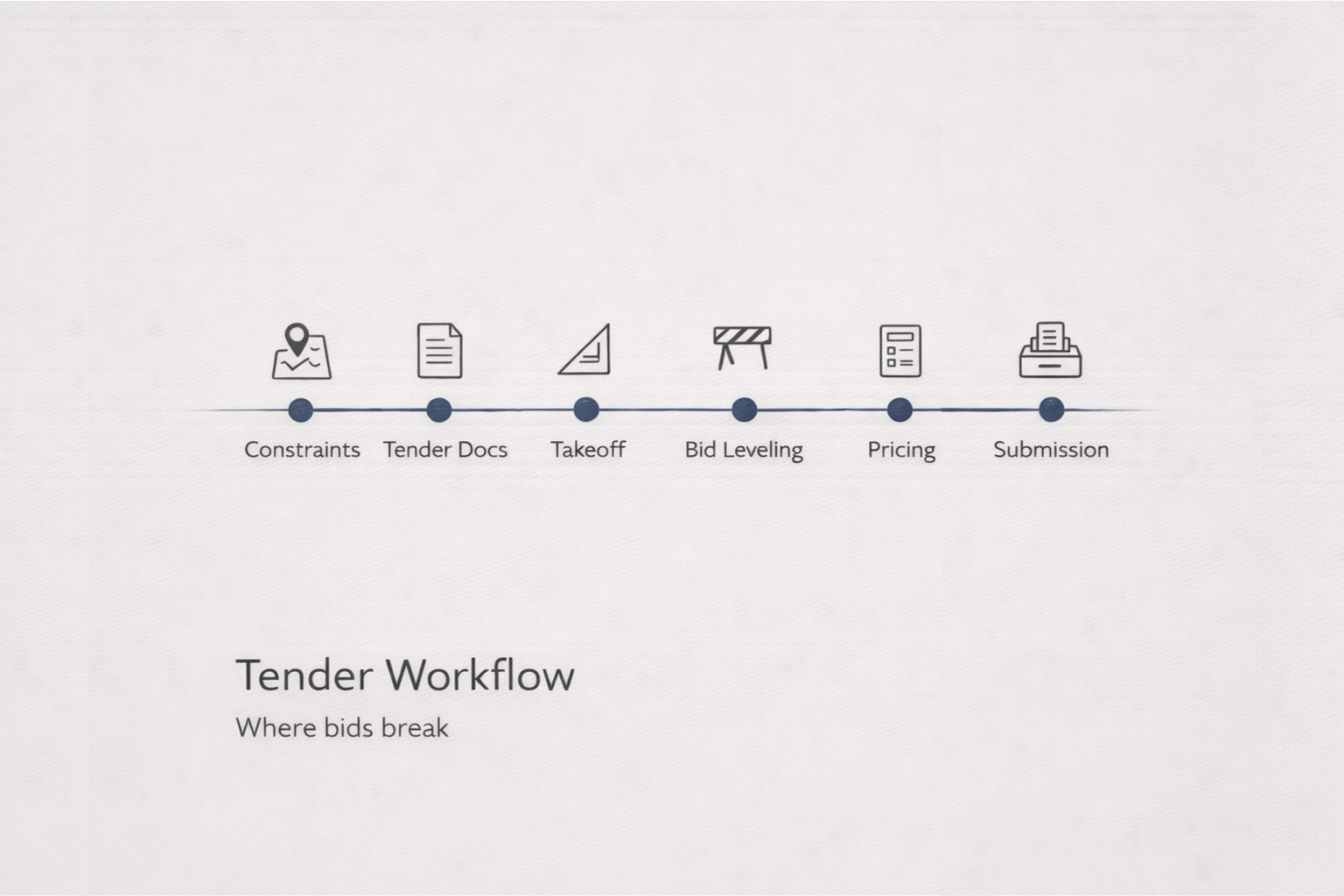
1) Before you estimate: read the job like you’re trying to catch yourself lying
Start with constraints, not quantities. Site access. Working hours. Laydown area. Crane picks. Noise rules. Winter conditions. Phasing. Live building. This is where the “cheap bid” turns into a loss.
If you’re doing a house or small build and you need a clean sequence baseline, keep this open in another tab: pre-construction steps you need to know.
Then read the front-end docs. Instructions to bidders. Bid form. Addenda rules. Allowances. Alternates. Unit rates. Bonds. Insurance. Schedule requirements. The drawings do not override the tender instructions on most jobs. That’s a common trap.
2) Takeoff: count the job, but also count the mess
Everyone knows to measure walls and concrete. The misses are the “boring” line items:
- Temp works: hoarding, fencing, heaters, tenting, temp power/water, protection, cleanup.
- Access + handling: elevators, stairs, staging, traffic control, street occupancy, deliveries.
- Hidden demolition: patching, firestopping repair, making good, disposal constraints.
- Water management: temporary drainage, pumps, dewatering, wet-weather protection.
If the project touches utilities, treat them as their own scope (and schedule driver), not a footnote: utilities and infrastructure.
3) Subcontractor bids: “leveling” is where adults get separated from gamblers
Most bid-day disasters are not your takeoff. They’re sub scopes that don’t match.
Simple rule: you can’t compare numbers until you compare scope. If one sub carried firestopping and another didn’t, you don’t have “two prices.” You have two different projects.
Practical move: send each trade a one-page scope sheet. Same headings every time: included, excluded, assumptions, schedule, permits/inspections, temporary works, warranties. You’ll still get chaos, but it’s less blind.
4) Pricing: build it up so you can defend it later
Base cost: labor + material + equipment + subs + rentals + disposals.
Then add the things people pretend don’t exist: supervision, safety, QA/QC, temporary works, small tools, permits, testing, layout, cleanup, winter conditions.
Then markup: overhead and profit. Separate in your brain even if you lump it on the tender. Overhead keeps the lights on. Profit is what makes the risk worth taking.
Allowances: use them when information is truly missing, and describe what they cover. “Allowance” is not a magic word. It’s a future argument unless it’s specific.
Contingency: don’t hide it as a secret number if the tender format asks you to show it. If you can’t show it, you still need it internally.
5) Clarifications and exclusions: write them like you’ll be deposed later
This is where “human language” matters.
Clarifications are what you included and how you interpreted the docs.
Exclusions are what you did not price.
Keep them short. Specific. No novels.
- Good: “Price includes one mobilization and one demobilization. Night work excluded.”
- Bad: “All work by others as required.” (that’s how you lose friends and money)
6) Submission: lose bids on paperwork, not on price (it happens constantly)
Bid forms, bid bond, insurance forms, acknowledgment of addenda, subcontractor lists, schedule forms, anti-collusion, safety declarations. It’s tedious. It’s real.
If you’re bidding public work in the U.S., these are the official federal foundations people end up referencing:
- FAR Part 36 (Construction and Architect-Engineer Contracts) — where federal construction-specific rules live.
- FAR Part 14 (Sealed Bidding) — the “submit by deadline, open bids” framework.
- FAR Part 15 (Contracting by Negotiation) — when it’s proposals, discussions, best-value, not low bid only.
- SAM.gov Contract Opportunities — where many federal opportunities get posted and tracked.
If you’re bidding public work in Canada, this is the clean starting point: CanadaBuys.
Bonds: what they are and why they suddenly matter
If the tender asks for bid/performance/payment bonds and you ignore it, you’re not “saving money.” You’re non-compliant.
Two official links worth bookmarking:
- SBA Surety Bond Guarantee Program — helps smaller contractors qualify for bonding (if that’s your choke point).
- U.S. Treasury surety bond resources — where “acceptable surety” talk usually points back to.
The not-obvious move that makes tendering easier
Do a 20-minute “scope read-back” before you submit.
Literally read your own tender like you’re the owner trying to find what you forgot. Out loud if you can. It feels dumb. It works.
You’re listening for the quiet traps: “Who owns sealing penetrations?” “Who restores firestopping after MEP?” “Where do we stage?” “How do we keep water out during weeks 3–8?” “What did we assume about working hours?”
If you can’t answer a question in one sentence, it’s probably not defined. That’s where the job bleeds.
What to Check Before You Submit
Last hour is where money gets lit on fire. Not because you “can’t estimate.” Because you miss one clause, one addendum, one scope gap, and you just volunteered to pay for it.
- Addenda log: list every addendum number/date and confirm it’s carried into your price, scope, and schedule. If you can’t prove you priced it, assume you didn’t.
- Bid form + instructions to bidders: bonds, insurance limits, bid security, unit prices, alternates, allowances, and submission rules. This stuff overrides your “normal practice.”
- Scope map: write “included / excluded / by others” for the messy interfaces: demo, temp works, shoring, firestopping, sealants, patch/paint, final cleaning, testing, permits, commissioning, disposal.
- Clarifications in writing: if something is unclear, submit an RFI or clarification before closing. If you “assume,” you own the assumption.
- Sub quotes sanity: confirm numbers include the same scope, same specs, same addenda, same schedule. Watch the classic traps: “excludes delivery,” “excludes hoisting,” “daywork rates apply,” “price valid 7 days.”
- Schedule reality: check long-leads (steel, glazing, switchgear, RTUs, elevators). If the tender schedule is fantasy, you need an explicit qualification or you’ll wear the delay.
- Site constraints priced: access, laydown, cranes, night work, noise rules, winter conditions, live building rules, traffic control, dust control, disposal routes. These aren’t “general conditions” vibes. They’re dollars.
- Risk line items: don’t bury risk inside random divisions. Carry a visible contingency/qualification strategy: known unknowns, unit rates, allowances that are actually realistic.
- Submission proof: correct forms signed, correct attachments, correct portal/upload rules, time stamped. Late is dead. Wrong file is dead. Missing bond is dead.
If you only do one thing: write a one-page “bid summary” for yourself before you hit submit: price, inclusions, exclusions, assumptions, addenda counted, schedule notes. That page saves you when the fight starts later.
-
Download the free tendering checklist PDF. It’s quick to use and flags the common misses before you submit.
Manufacturer docs
(why they matter in tendering)
A lot of bids lose money because labor and accessories were priced like “generic install,” but the actual system is not generic. If you’re pricing enclosure work, pulling the manufacturer install manual is not nerd behavior. It’s how you avoid unpaid extras.
- ZIP System installation manual (PDF) — good example of how surface prep, rollers, temperature, and sequencing create real labor.
- DuPont Tyvek WRB + flashing install guidance (PDF) — good example of “this is how we expect you to detail it” language that affects scope.
- Tremco technical resources — data sheets that stop the classic “wrong sealant on wrong substrate” mess.
FAQ
Should I bid low just to win?
If you’re low because you’re efficient, fine. If you’re low because you missed scope, you didn’t “win.” You just delayed the pain.
Why do I keep losing when I feel like my number is fair?
Most common reasons: someone else assumed less scope, someone else took more risk, or you lost on compliance (forms, bonds, addenda, schedule requirements).
What’s the fastest way to blow up a tender?
Vague scope + no clarifications + hoping subs covered everything. Second place: accepting a sub quote that excluded the ugly parts (protection, patching, firestopping, access).
What do I do when drawings are incomplete?
Price what’s shown, then write tight clarifications and allowances for what isn’t. If you don’t write it down, you basically donated it.
What should I track during bid day?
Addenda list, sub quote versions, inclusions/exclusions, and a short “what changed today” note. If you can’t reconstruct bid day later, you’re exposed.