
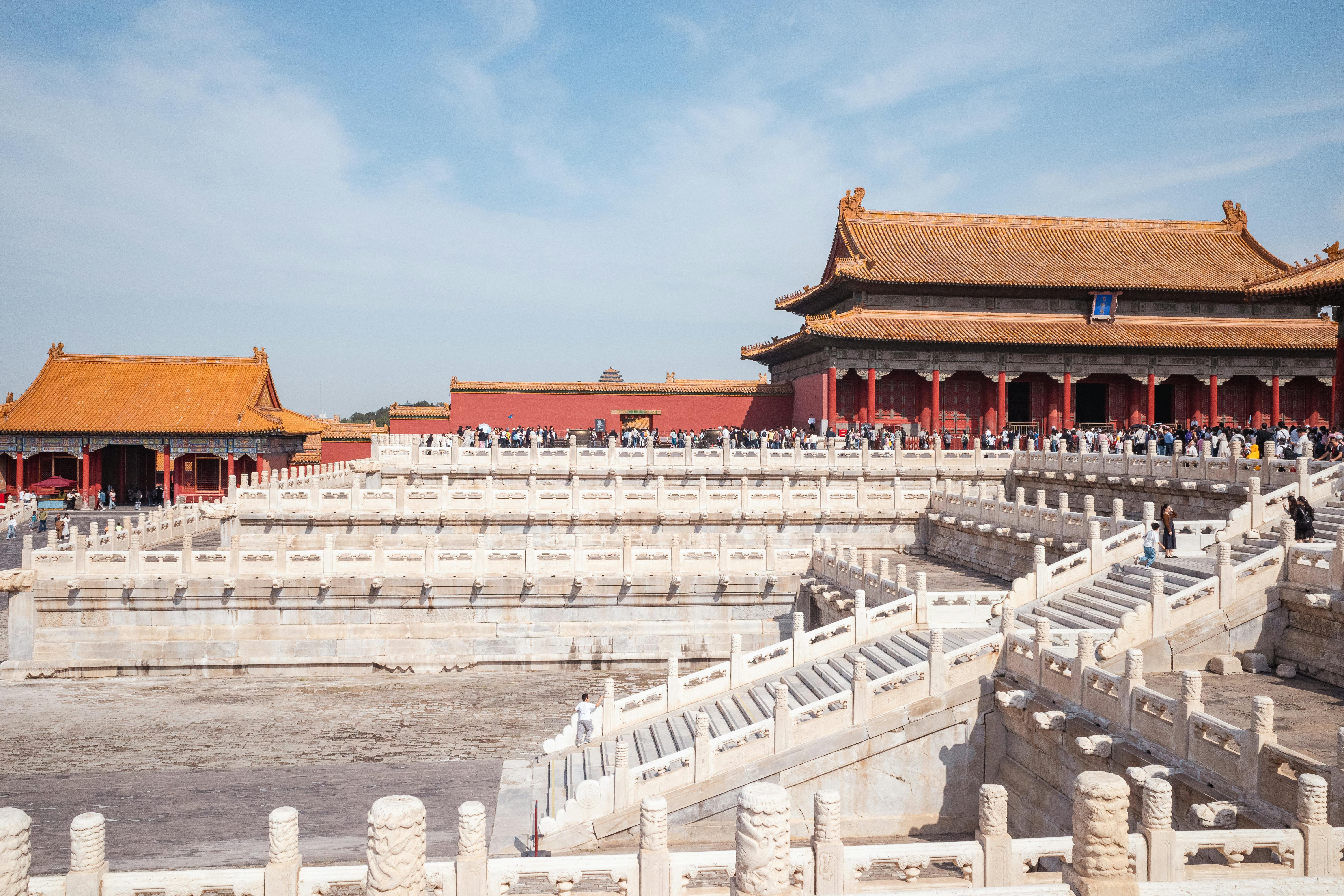
What Really Made the Forbidden City So Powerful?
More than a palace, the Forbidden City was a machine for power. Below, we break down what made it function—architecturally, politically, and symbolically.
Quick Start: What You Need to Know First
✓ It's not one palace—it's 980 buildings
✓ Built between 1406–1420 by over a million workers
✓ Symbolic layout: everything is placed for power, hierarchy, and Confucian order
✓ Today it's called the Palace Museum
✓ Ticket prices range around 60 RMB (approx. $8 USD)
Sections Coming Next:
- Chinese Architecture
- What the Forbidden City Was Actually For
- Key Architecture You Should Notice (Not the Obvious Stuff)
- What Tourists Usually Miss
- The Forbidden City Today: Crowds, Routes, Real Tips
- Cultural and Symbolic Layers
- FAQ
Why Was the Forbidden City Built the Way It Was?
Inside the Forbidden City: Real Architecture, Real Purpose
Chinese Architecture: Tradition Engineered Into Form
Chinese architecture isn’t about style—it’s about symbolism, spatial control, and structural balance. From wood beam frameworks to intricate rooflines, the built environment was seen as a reflection of natural and cosmic order.
Why Chinese Architecture Still Matters
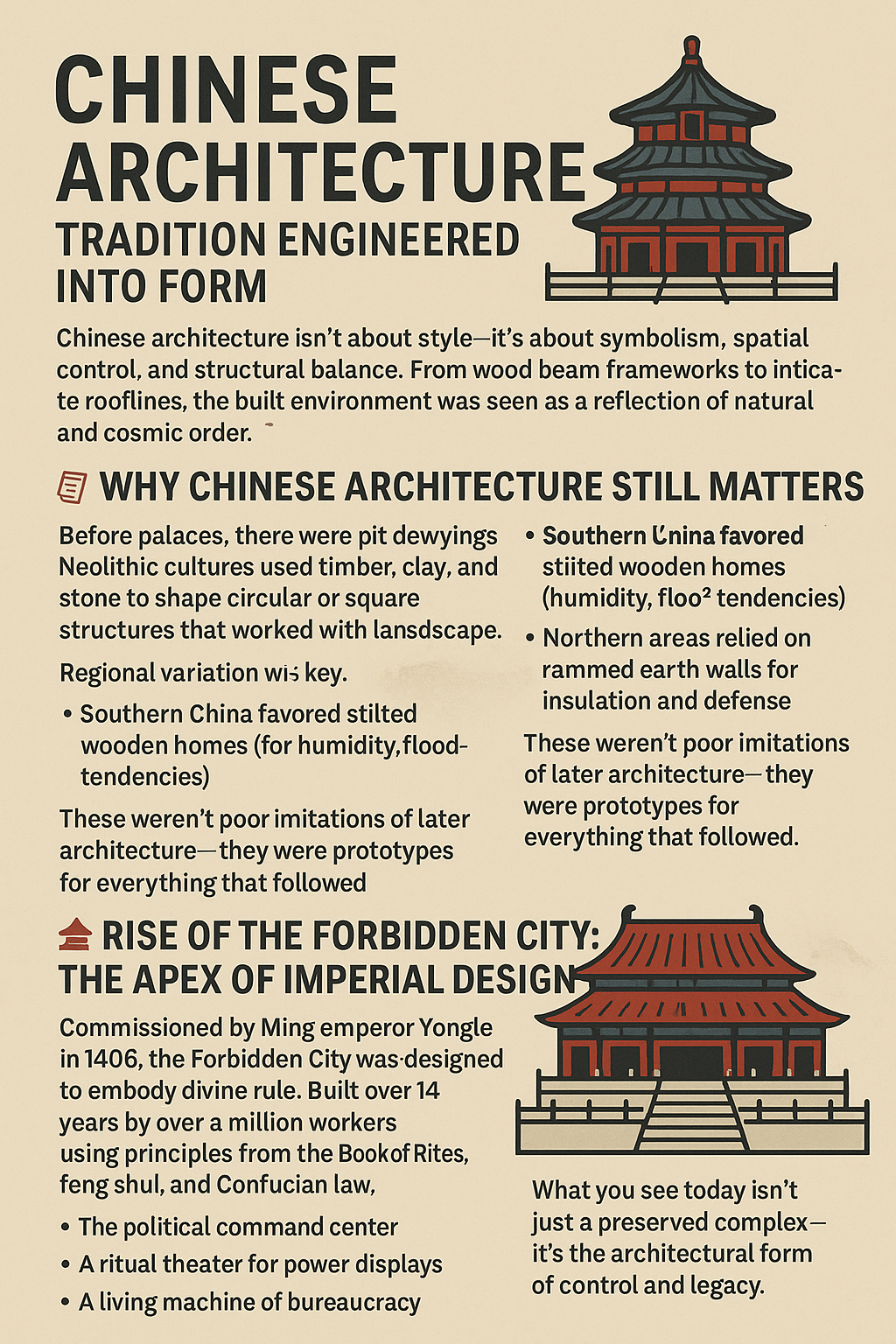
You can’t study history without studying its architecture. Every dynasty left a blueprint of how it saw power, space, and life:
▪ The Zhou introduced axial planning.
▪ The Han scaled it into cities.
▪ The Tang refined aesthetics and cosmology.
▪ The Ming and Qing locked it into tradition—exemplified by the Forbidden City.
Early Chinese Architecture: Humble Starts, Clever Systems
Before palaces, there were pit dwellings. Neolithic cultures used timber, clay, and stone to shape circular or square structures that worked with—not against—the landscape.
Regional variation was key:
● Southern China favored stilted wooden homes (humid, flood-prone)
● Northern areas relied on rammed earth walls (for insulation and defense)
These weren’t poor imitations of later architecture—they were prototypes for everything that followed.
Rise of the Forbidden City: The Apex of Imperial Design
Commissioned by Ming emperor Yongle in 1406, the Forbidden City was designed to embody divine rule. Built over 14 years by over a million workers, it used principles from the Book of Rites, feng shui, and Confucian law.
It became:
● The political command center
● A ritual theater for power displays
● A living machine of bureaucracy and surveillance
What you see today isn’t just a preserved complex—it’s the architectural form of control and legacy.
What the Forbidden City Was Actually For
The Forbidden City wasn’t built to be admired. It was built to control.
This place was the nerve center of imperial China. Every hall, gate, and courtyard had a purpose, from managing foreign policy to deciding how many bowls of rice a prince should get. If you were inside, you mattered. If you weren’t, you didn’t.
For nearly 500 years, from the Ming to the Qing dynasty, the Forbidden City was home to emperors, consorts, eunuchs, soldiers, scribes, and spies. It was a machine of hierarchy and symbolism.
■ The central axis? That wasn’t for balance. It reinforced the emperor’s role as the cosmic center.
■ The gates? Each had ranks attached. You didn’t walk through the wrong one if you wanted to keep your head.
■ The names? Not poetic fluff. "Hall of Supreme Harmony" meant the emperor had heaven’s blessing to rule. Every word was a warning and a flex.
The Forbidden City wasn’t just closed off from the public. It was designed to remind you that your power, your status, your survival—came from the emperor.
Even the silence inside was curated. Guards padded silently, eunuchs bowed deeply, and scribes knew better than to speak unless summoned.
Modern visitors walk freely, snapping selfies. But the bones of control are still there. You just have to look.
Forbidden City Architecture: Design, Function, and Control
Forbidden City Architecture and Layout: Built to Control, Impress, and Endure
The Forbidden City wasn’t just constructed—it was choreographed. Every gate, courtyard, and hall was deliberately placed to reinforce hierarchy, exert control, and project imperial power.
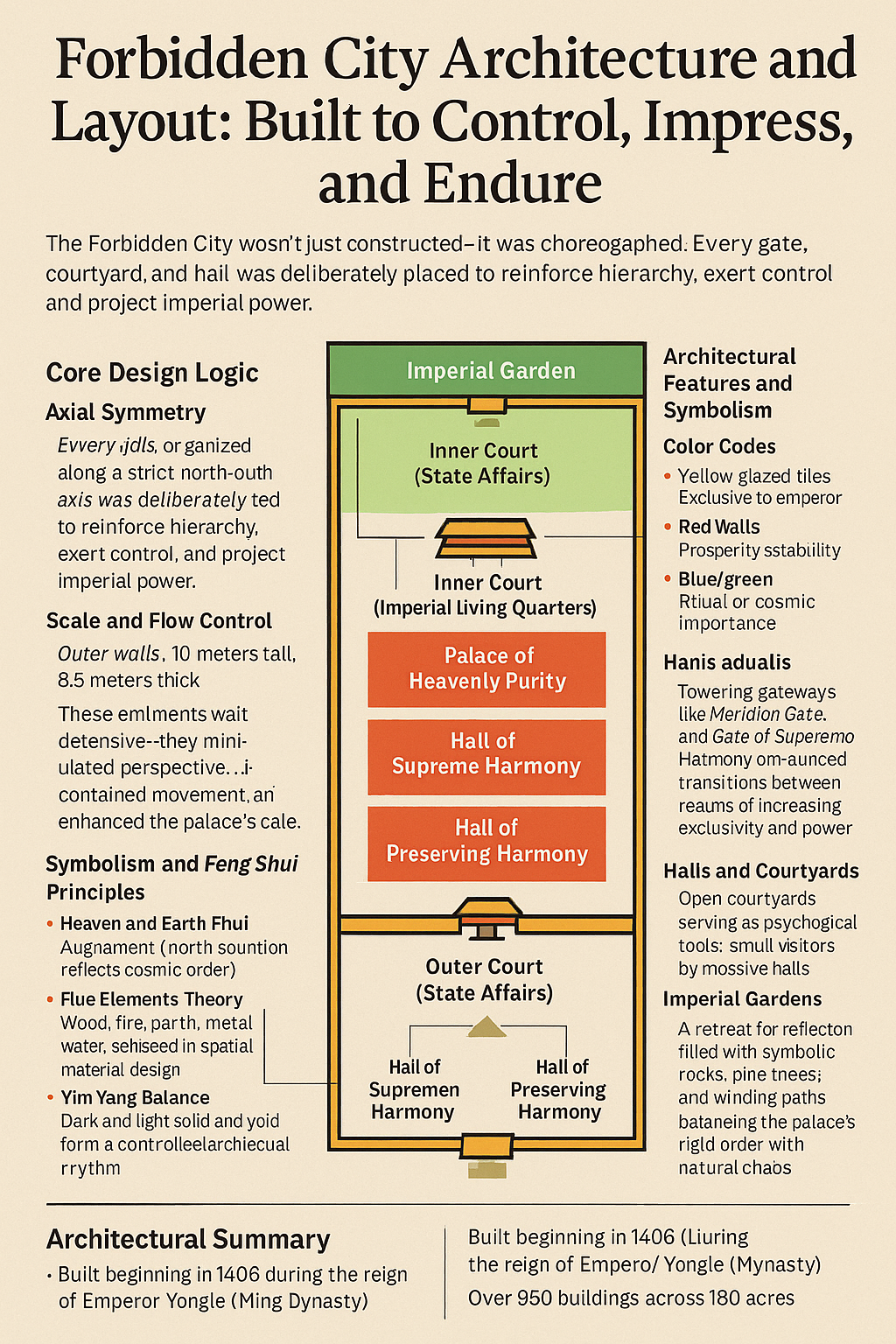
Core Design Logic
- Axial Symmetry: The entire palace is organized along a strict north-south axis. This alignment placed the emperor at the literal and symbolic center of the universe. Power radiated outward in layers.
- Scale and Flow Control:
- Outer walls: 10 meters tall, 8.6 meters thick
- Moat: 52 meters wide These elements weren’t just defensive—they manipulated perspective, contained movement, and enhanced the palace’s theatrical scale.
- Hierarchical Zones:
- Outer Court (State Affairs):
- Hall of Supreme Harmony
- Hall of Central Harmony
- Hall of Preserving Harmony
- Inner Court (Imperial Living Quarters):
- Palace of Heavenly Purity
- Hall of Union
- Palace of Earthly Tranquility
- Outer Court (State Affairs):
Architectural Features and Symbolism
- Color Codes:
- Yellow glazed tiles = Exclusive to the emperor
- Red walls = Prosperity and stability
- Blue/green = Ritual or cosmic importance
- Gates and Walls:
- Towering gateways like Meridian Gate and Gate of Supreme Harmony announced transitions between realms of increasing exclusivity and power.
- Halls and Courtyards:
- Open courtyards served as psychological tools—small visitors dwarfed by massive halls.
- Large spaces controlled crowd behavior and focused all attention toward the throne.
- Imperial Gardens:
- The Imperial Garden at the north end was a retreat for reflection, filled with symbolic rocks, pine trees, and winding paths—balancing the palace’s rigid order with natural chaos.
Symbolism and Feng Shui Principles
Chinese cosmology and Feng Shui drove the entire layout:
- Heaven and Earth Alignment: North-south orientation reflects the cosmic order.
- Five Elements Theory: Wood, fire, earth, metal, water are echoed in spatial and material design.
- Yin-Yang Balance: Dark and light, solid and void, form a controlled architectural rhythm.
Architectural Summary
- Built beginning in 1406 during the reign of Emperor Yongle (Ming Dynasty)
- Over 980 buildings across 180 acres
- 9,999 rooms (symbolic maximum; 10,000 was reserved for heaven)
The Forbidden City remains a monumental blueprint of how architecture was used not only to house power, but to perform it.
What Most Tourists Miss About the Forbidden Palace
What Life Inside the Palace Was Actually Like
Forget sweeping shots—daily life inside the palace was tightly choreographed. Even private moments were part of a system.
● The emperor’s day: Started before sunrise. He read memorials from ministers, held court in the Outer Halls, and was constantly monitored by eunuchs.
● Eunuchs: Some held enormous power (especially during the late Ming), others were simply domestic labor. They had access to everything—but no personal lives.
● Concubines: Ranked, rotated, and relocated based on the emperor’s whim. Some spent their entire lives in the Inner Court without ever seeing him.
● Servitude, not splendor: Rooms were cold, dark in winter. Rituals governed everything—where you stood, what you wore, how you bowed.
Image suggestion:
📷 Filename: daily-life-forbidden-city.jpg
Alt text: Reconstruction painting showing a day in the Forbidden City’s Inner Court
Meta caption: A glimpse into the highly regulated, rigid life inside the Forbidden City—beyond the ceremonial halls.
The Forbidden City vs. Beijing's Other Palaces: Key Differences
How the Forbidden City Compares to Other Imperial Palaces
It wasn’t the only imperial palace—but it set the standard. Here’s how it stacks up against others:
| Palace | City | Key Traits |
|---|---|---|
| Forbidden City | Beijing | Largest; ceremonial dominance; Ming/Qing dynasties |
| Mukden Palace | Shenyang | Smaller scale; Qing origins; blended Manchu + Han architecture |
| Imperial Palace | Hue (Vietnam) | Inspired by Forbidden City; Vietnamese elements and feng shui-influenced layout |
| Summer Palace | Beijing | Leisure-focused; lake-centered; elegant gardens over strict order |
Key differences:
▪ The Forbidden City is monumental and symbolic.
▪ Mukden is hybrid and regional.
▪ Hue is a scaled-down cousin.
▪ The Summer Palace was built for pleasure, not power.
How to Spot the Hidden Design Logic Inside the Forbidden City
At first glance, the Forbidden City looks like repetition: gates, halls, symmetry, red walls. But it’s not just aesthetic—it’s calculated. Every inch serves a purpose. If you know what to look for, you’ll see a design system built to enforce order, reflect hierarchy, and control perception.
Here’s how to read it like an architect, not a tourist:
1. The Central Axis Isn’t Just for Show
The Forbidden City is built around a single north-south axis—a spine of power.
▪️ The emperor’s throne sits dead center.
▪️ All major halls align with this axis.
▪️ The farther you are from the center, the lower your status.
▶ Why it matters: This axis wasn’t just visual—it was symbolic. Being "off-axis" meant you were literally off the emperor’s radar. The layout encoded political rank into spatial experience.
2. Courtyards as Filters of Power
Each courtyard you pass through narrows your access. Think of them as filters, not just open space.
▪️ Outer courtyards = ritual and bureaucracy
▪️ Inner courtyards = domestic life and imperial secrets
▪️ Gates = checkpoints for identity and permission
▶ What to look for: Notice how thresholds shrink, colors shift, and elevation rises as you move inward. You're not just walking—you’re being sorted.
3. Roofs Speak in Rank
Pay attention to roof corners and tiles. They literally indicate power.
▪️ The number of roof beasts (mythical figures) = rank of building
▪️ Yellow glazed tiles = reserved for the emperor
▪️ Green or black tiles = lower nobility or functionary buildings
▶ Pro tip: The Hall of Supreme Harmony has 10 beasts. That’s the architectural equivalent of wearing every medal at once.
4. Columns Aren’t Just Support
Each hall is lined with imposing wooden columns. But here’s the trick: they’re spaced deliberately uneven—wider at entrances, tighter near the throne.
▶ Why: It draws the eye inward, creating forced perspective and framing the emperor as larger than life—literally. This isn’t just engineering. It’s psychological architecture.
5. Spatial Silence: What’s Not There Also Matters
Look at the blank spaces. The long walls. The quiet courtyards.
▶ They’re not empty. They’re intentional pauses.
Chinese architecture uses voids as structure—creating contrast, directing flow, and building tension. The wall isn’t just what you walk past. It’s what forces your movement.
What You Should Actually Be Looking For
If you want to really see the Forbidden City:
▪️ Don’t just admire the symmetry—ask what it's hiding
▪️ Don’t skip small halls—they often served key roles for surveillance or preparation
▪️ Walk slow. Count stairs. Watch how gates frame space
▪️ Look for shifts in material, elevation, tile color, and scale—they all tell you who mattered and who didn’t
How the Forbidden City Reshaped Chinese Architecture and Urban Power
What Made the Forbidden City a Blueprint for Imperial China
The Forbidden City wasn’t just a palace. It became the master template for how imperial power was meant to look, feel, and function. From its north-south axis to the calculated use of space and symbolism, it turned architecture into propaganda.
- Axial planning: Every major imperial site that followed used it. Straight lines. Layered hierarchy.
- Symbolic zoning: Separation of state (Outer Court) and private life (Inner Court).
- Copycat palaces: Mukden Palace in Shenyang and Chengde Mountain Resort mimic its flow, proportions, and symbolic color schemes.
Beyond Walls: How It Shaped Entire Cities
The Forbidden City redefined how cities were organized around power.
- Center-first planning: Beijing, and later cities, placed political control at the center, radiating outward.
- Gate alignment and orientation: Southern-facing gates became the standard across the empire.
- Hierarchy through streets: Access narrowed as one approached power—broad avenues outside, tight corridors inside.
What Preservation Got Right (and What It Missed)
The Wins:
- UNESCO status (1987) brought in global support and oversight.
- The Palace Museum turned parts of the Forbidden City into one of the most visited cultural heritage sites on earth.
- Use of traditional craft: Restoration efforts have revived dying techniques—from glazed tile production to wooden beam carving.
The Misses:
- Over-restoration: Some areas lost authenticity through modern materials and over-cleaning.
- Tourist overload: High foot traffic accelerates wear on original stone paths and paintwork.
- Tech lag: Some sections still lack modern monitoring tools (humidity sensors, microcrack detection).
What Still Needs to Be Done
- True regional collaboration: Lessons from Shenyang and Chengde could guide preservation standards.
- Digital archiving: 3D scans, VR walk-throughs, and AI-based structural analysis should be systematized.
- Better narrative framing: Current exhibits often isolate objects. The full spatial story of how power moved through the palace is underutilized.
What to Look For When You Visit
- Transition points: Stand at Meridian Gate or Gate of Supreme Harmony. Watch how scale, sound, and air shift.
- Material wear: In older corners, study how stone has weathered—some footpaths are smooth from centuries of footsteps.
- Functional silence: In service corridors and eunuch quarters, note how tight angles and narrow halls speak volumes about control.
The Forbidden City is more than preserved history. It’s a working model of how architecture, ideology, and politics were fused into a machine of imperial control. If we don’t study it deeply and preserve it smartly, we’re not just losing buildings—we’re losing one of the most sophisticated forms of architectural storytelling ever built.