

Free Architecture Books That Are Actually Free
Most free architecture book lists are a mess.
They mix public-domain classics, borrowed scans, open-access books, and pirated PDFs as if those are the same thing. They are not.
Spend ten minutes searching and you hit the same junk every time: a broken PDF button, a spam page pretending to host a modern textbook, then an Internet Archive listing that only lets you borrow the book for an hour.
The clean way to do this is to separate the sources properly. Some books are real downloads. Some are legal read-online or borrow-only copies. Some come from official publishers and museum libraries. Once you split the pile that way, the whole subject gets easier.
Start Here
| Source | Best Use | What to Watch For |
|---|---|---|
| Project Gutenberg | Public-domain architecture classics you can download and keep | Strong for older history and theory, weak for current student textbooks |
| Internet Archive | Older scans, out-of-print manuals, drawing books, older editions | Some listings are real downloads, many newer ones are borrow-only |
| Getty Virtual Library | Free official PDFs in architecture, criticism, conservation, and history | Better for serious reading than quick studio help |
| MIT Press Open | Legitimate open-access books in architecture and urban studies | Usually more specialized than beginner-friendly |
| USDA, FEMA, NPS | Wood, construction, preservation, and building guidance manuals | Practical and useful, but usually dry |
If you stay inside those five and ignore the sketchy PDF farms, you avoid most of the garbage right away.
Project Gutenberg
This is the cleanest place to start.
There is no guessing. The books are public domain. Download them. Keep them. Read them anywhere.
And no, this is not where you go for current studio books. This is where you go for the older texts that shaped how architecture was argued, judged, and written about before the modern publishing machine took over.
Good First Picks
Vitruvius, The Ten Books on Architecture
Still the obvious starting point if you want the old three-part logic in one place: firmness, utility, delight.
Project Gutenberg
John Ruskin, The Seven Lamps of Architecture
Still sharp. Still opinionated. Still useful when you want to remember that architecture is bigger than systems and compliance.
Project Gutenberg
John Ruskin, Lectures on Architecture and Painting
Less famous than Seven Lamps, but easier to get through if you want a cleaner doorway into nineteenth-century architectural thinking.
Project Gutenberg
Edith Wharton and Ogden Codman, The Decoration of Houses
Old, yes. Still very good on proportion, clutter, and how rooms go wrong. Worth reading if you keep treating interiors like a side issue.
Project Gutenberg
Elsie de Wolfe, The House in Good Taste
Better for atmosphere and lived-in rooms than technical knowledge, but still useful if you want to see how early interior writing carried itself before everything became showroom fluff.
Project Gutenberg
Grace Wood and Emily Burbank, The Art of Interior Decoration
Another older interior book that still helps when you are trying to understand room composition instead of just collecting references.
Project Gutenberg
Worth Knowing: if the bigger gap is history, go next to Introduction to History of Architecture. If the gap is theory, use Architectural Theory.
Internet Archive
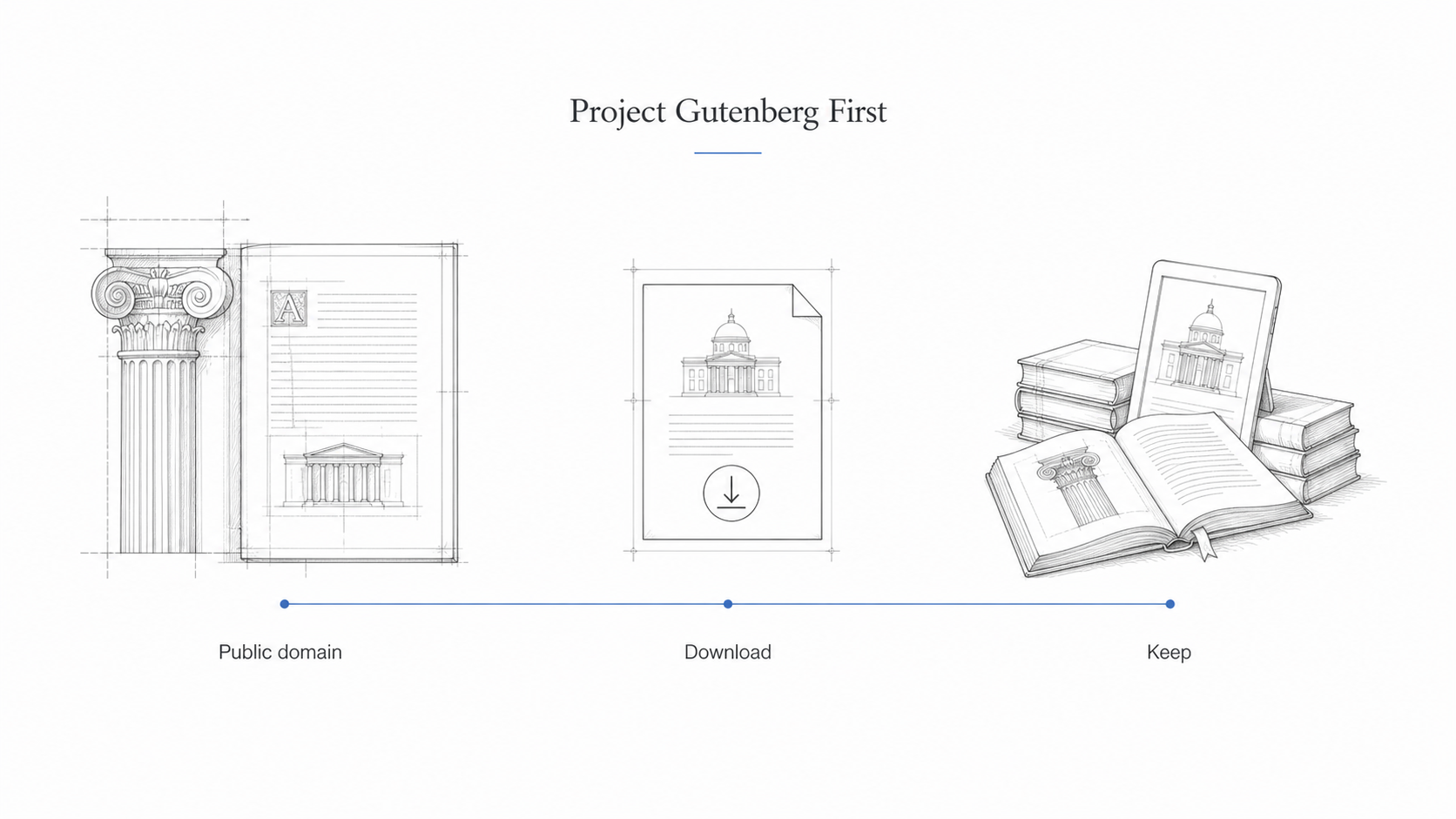
Illustration by ArchitectureCourses.org. Project Gutenberg is the clean public-domain lane. Archive gets more useful once you want older scans, drawing books, and odd manuals that are harder to find anywhere else.
Archive is where the older technical books start showing up.
That is the real value here. Drawing manuals. Trade books. Strange in-between texts. Older editions that vanished from normal bookstores years ago.
And yes, one weird old drawing book can still teach more than a polished new video. Redraw one plate from an old manual and you will see very quickly how loose most beginner work really is.
Older Books Still Worth Opening
Andrea Palladio, The Four Books of Architecture
Not because you are going to design villas in Vicenza. Because it forces you to slow down and look at proportion, sequence, and formal control.
Internet Archive
A. D. F. Hamlin, A Text-Book of the History of Architecture
Still one of the cleaner older surveys if you want one broad history book that actually moves.
Internet Archive
Fred T. Hodgson, Builder’s Architectural Drawing Self-Taught
One of the best older drawing books if you care about drawing as work, not mood. Architects, carpenters, and woodworkers were all still close enough here that you can feel it.
Internet Archive
William A. Radford, Radford’s Architectural Drawing
Old-school office drawing logic. Scale, tracing, lettering, detailing, rendering. Very useful if your drawings still look like software output instead of actual decisions.
Internet Archive
These books are old enough to be free. That does not make them current on code, products, or present-day compliance language.
Use them for drawing discipline. Not for current regulations.
If that is the gap you are trying to fix, pair them with Building Materials and Woodworking Basics.
Free Collections Worth Opening
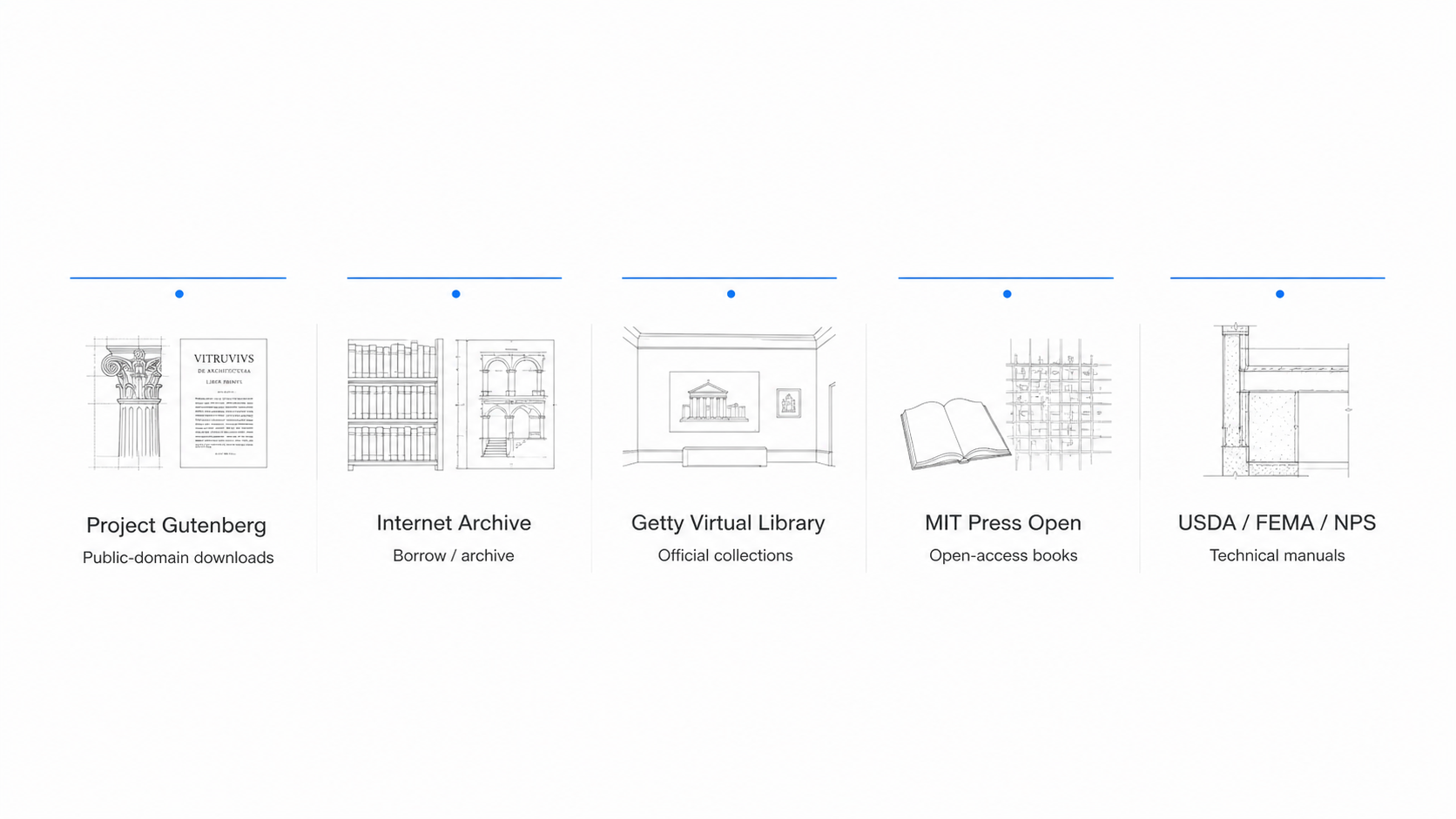
Illustration by ArchitectureCourses.org. The useful split is simple: public-domain downloads, borrow-only archives, official free collections, open-access publishers, and technical manuals.
This is where most book lists get thin.
The best free architecture reading online is not always one famous title. Sometimes the source itself is the good find.
Getty Virtual Library
Getty’s Virtual Library is one of the cleanest free sources online. No shady mirrors. No fake scarcity. No guessing whether the PDF is legal.
Start there if you want architecture writing that feels more serious than student listicles and less scattered than Archive.
- Getty Virtual Library
- The Genius of Architecture
- Style-Architecture and Building-Art
- Précis of the Lectures on Architecture
MIT Press Open Architecture and Urban Studies
This is the better lane when you want legitimate open-access architecture books and are tired of pretending modern architecture publishing has no free side at all.
Technical Manuals That Do Real Work
If your interest is drifting away from book-list territory and toward how buildings actually behave, this is where the useful free material lives.
- USDA Wood Handbook
- National Park Service Preservation Briefs
- NPS Preservation Brief 17: Architectural Character
- FEMA Building Science Publications
This is the material people keep coming back to after they realize another glossy “best architecture books” list did not help them draw, detail, repair, or judge anything more clearly.
What to Use and What to Skip
| If You Need | Use | Skip |
|---|---|---|
| Older theory and foundational reading | Project Gutenberg classics | Sketchy PDF sites pretending to have current textbooks |
| Older drawing discipline | Internet Archive public-domain manuals | Random Pinterest sheets with no source |
| Preservation, old buildings, and repair guidance | NPS Preservation Briefs and FEMA manuals | Forum posts dressed up as technical advice |
| Wood and material behavior | USDA Wood Handbook | Generic product-blog summaries |
| Current visual fundamentals for school | Buy or borrow one modern book and pair it with free classics | Spending two hours hunting a fake “free” Ching scan |
Stop Looking for a Free Ching PDF
This is the part most pages avoid saying clearly.
If you want Francis D.K. Ching, Simon Unwin, or other modern classroom staples, stop pretending the clean legal download is hiding one page deeper in the search results. Most of the time it is not.
Put your free-reading energy into books that are actually free. Then buy, borrow, or library-loan the modern books that still do the visual heavy lifting for students.
That split works better anyway. The older books give you history, proportion, and arguments. The modern books translate that into drawings you can actually use now.
Field Pick: Architecture: Form, Space, and Order
Also Useful: Analysing Architecture and The Language of Architecture.
If you want the cleaner in-site versions of that path, use Beginners Architecture Books, Francis D.K. Ching Books, and Architecture Books.
Read in This Order
Most people do better with one small stack than with a giant archive tab collection they never revisit.
- Start with one public-domain theory or history book. Vitruvius or Ruskin is enough.
- Add one older drawing manual. Hodgson or Radford works.
- Add one technical manual on wood, preservation, or building performance.
- Then pair all of that with one modern visual book or one free course.
That is enough.
You do not need fifty tabs to get moving.
Read This Next: if you want courses beside the books, use Free Architecture Courses. If you want a more structured beginner path instead of random reading, use Free Architecture Courses With Certificates.
What People Get Wrong
They mix up four different things:
- public-domain downloads
- borrow-only library copies
- open-access scholarly books
- pirated uploads with missing pages
That is why these pages get messy so fast.
The second mistake is treating a book list like progress.
Reading helps. But if you are trying to learn architecture, the book has to turn into something: a sketch, a measured drawing, a room plan, a detail sheet, a sharper critique of a building you already know.
Otherwise it is just collecting PDFs.
Questions People Actually Ask
Are these books really free?
The Project Gutenberg, Getty, USDA, FEMA, and NPS links here are genuinely free. Archive links vary by item, which is why you have to read the label.
Can I get current architecture textbooks free?
Usually no. Some modern books are borrowable. A few are open access. Most are still under copyright and need to be bought or borrowed properly.
Is Internet Archive still worth using?
Yes, especially for older books, drawing manuals, and public-domain scans. It gets much less useful when people treat every listing like a permanent free PDF.
What is the best free source for older architecture theory?
Project Gutenberg first.
I care more about buildings than theory. Where should I start?
Start with one older drawing manual, then jump to the USDA Wood Handbook or the NPS Preservation Briefs. That gets you into materials, assemblies, and real building behavior much faster than another abstract essay.
Can these replace architecture school?
No.